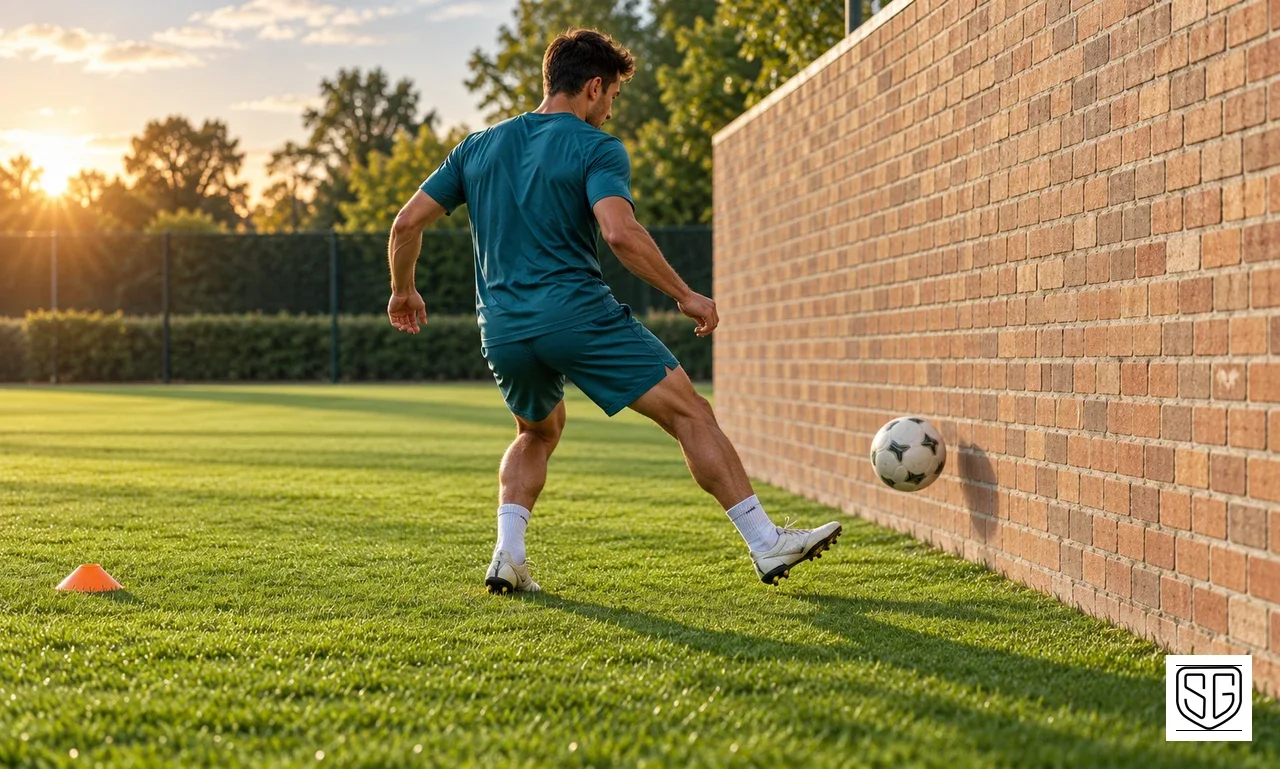
A useful first touch does more than stop the ball. It prepares the next pass, carry or shot. You can practise that decision and the movement behind it on your own, even without a team-mate feeding you passes. A safe wall, one ball and two small markers are enough for a focused session.
The coaching principles are straightforward: look before the ball arrives, adjust your angle, receive with a body shape that gives you options, and direct the ball into space. England Football's guidance on receiving emphasises scanning, timing and body orientation rather than treating control as an isolated trick. The exercises below are SportsGround's original solo adaptations of those principles, not an official England Football training programme.
Set up a repeatable practice area
Choose a wall you are allowed to use, a flat surface and enough clear space for the rebound. Keep away from roads, windows, other people and anything a missed pass could damage. Place one marker a few steps to your left and the other a few steps to your right. Start at a comfortable distance from the wall and strike controlled passes; harder is not automatically better.
Each rebound should have a purpose. Before it returns, briefly look towards one marker, decide which side you will exit and move your feet so you can receive across your body. England Football's guidance on preparation off the ball explains why checking the picture, finding an angle and setting up to play forward matter before the first touch happens.
A 24-minute solo first-touch session
Minutes 0-4: get comfortable with the rebound. Pass to the wall with your right foot and receive with your left, then reverse the pattern. Keep the ball within playing distance and make the next pass without chasing it. Use both the inside and outside of each foot. If the rebound is unpredictable, reduce the pace or move closer until you can make clean contact repeatedly.
Minutes 4-10: receive through a gate. Make a gate between your two markers, roughly a stride wide. Pass to the wall, glance towards the gate while the ball travels and use your first touch to take the rebound through it. Alternate left and right exits. A successful repetition is one where the ball passes through the chosen side and leaves you balanced enough to play again; merely brushing the ball with your boot does not count.
Minutes 10-16: open your body. Stand at a slight angle to the wall rather than square-on. Pass, move into the ball's path and let your first touch travel across your body towards the far marker. Return a pass with your second touch. Swap sides every few repetitions. This is a simple way to rehearse receiving so that your next action can go forward instead of straight back where the ball came from.
Minutes 16-20: add a decision cue. Before each pass, choose a left or right exit using a random cue: for example, a shuffled pair of coloured cards placed behind the ball. Look at the cue while the pass is travelling, then take your first touch in that direction. The cue should change often enough that you cannot plan every touch in advance. Keep the pass speed modest so the decision remains the challenge.
Minutes 20-24: finish with your weaker side. Use the foot you normally avoid to receive and pass. Widen the gate if necessary, then narrow it only when you can stay balanced and direct the ball deliberately. Quality matters more than forcing the same speed as your stronger foot.
Measure control, not just repetitions
For each drill, record how many of ten attempts put the ball through the intended gate and left you ready for the next action. That is a personal baseline, not a professional benchmark. Repeat the same setup later and compare your own score. Also note whether you scanned before the rebound, whether the ball stayed within a step, and whether the weaker foot needed extra touches. Change only one variable at a time, such as the gate width, distance or pass speed, so you can tell what made the drill harder.
If your touch regularly runs away, shorten the pass and soften your receiving foot. If the ball stops dead under you, angle your body earlier and push the touch towards the chosen space. If you keep looking only at the ball, slow the service until you can make a quick glance away and still meet the rebound cleanly. These adjustments keep the practice tied to the next football action rather than a raw touch count.
Solo work has a limit: a wall cannot behave like a defender or communicate like a team-mate. England Football's session guidance also discusses adapting practice as players develop. Take the same scanning and directional-touch habit into small-sided games or team training, where pressure, movement and real passing choices test whether it transfers. Your aim is not a flawless wall routine; it is a first touch that helps you play what you see.