A goalkeeper who controls the ball with their hands or arms inside their own penalty area for more than eight seconds before releasing it concedes a corner kick to the opponents. That is the current wording of IFAB Law 12. The corner is taken from the side nearest the goalkeeper's position when the referee penalises the offence. It is not an indirect free kick in the penalty area, and one infringement does not automatically mean a yellow card.
The rule sounds simple, but the questions fans usually ask are more precise: When does the referee start counting? Does a bounce reset the clock? What if an attacker blocks the keeper? The answers matter because the rule concerns control with the hands or arms, not every second that the goalkeeper has possession of the ball at their feet.
When does the eight-second count start?
The referee decides when the goalkeeper has clear control with their hands or arms. The count does not have to wait until the keeper stands up after catching a shot. IFAB's official explanation and Q&A specifically says that falling to the ground and then getting up does not postpone the start if the keeper already had clear control. That prevents a player from extending the time simply by staying down.
Law 12 describes control in several ways. It includes holding the ball between the hands or arms, trapping it between a hand or arm and another surface such as the ground or the keeper's body, holding it on an outstretched open hand, and bouncing it or throwing it into the air. A goalkeeper cannot restart the eight seconds by bouncing the ball. IFAB's Law 12 FAQ addresses that point directly.
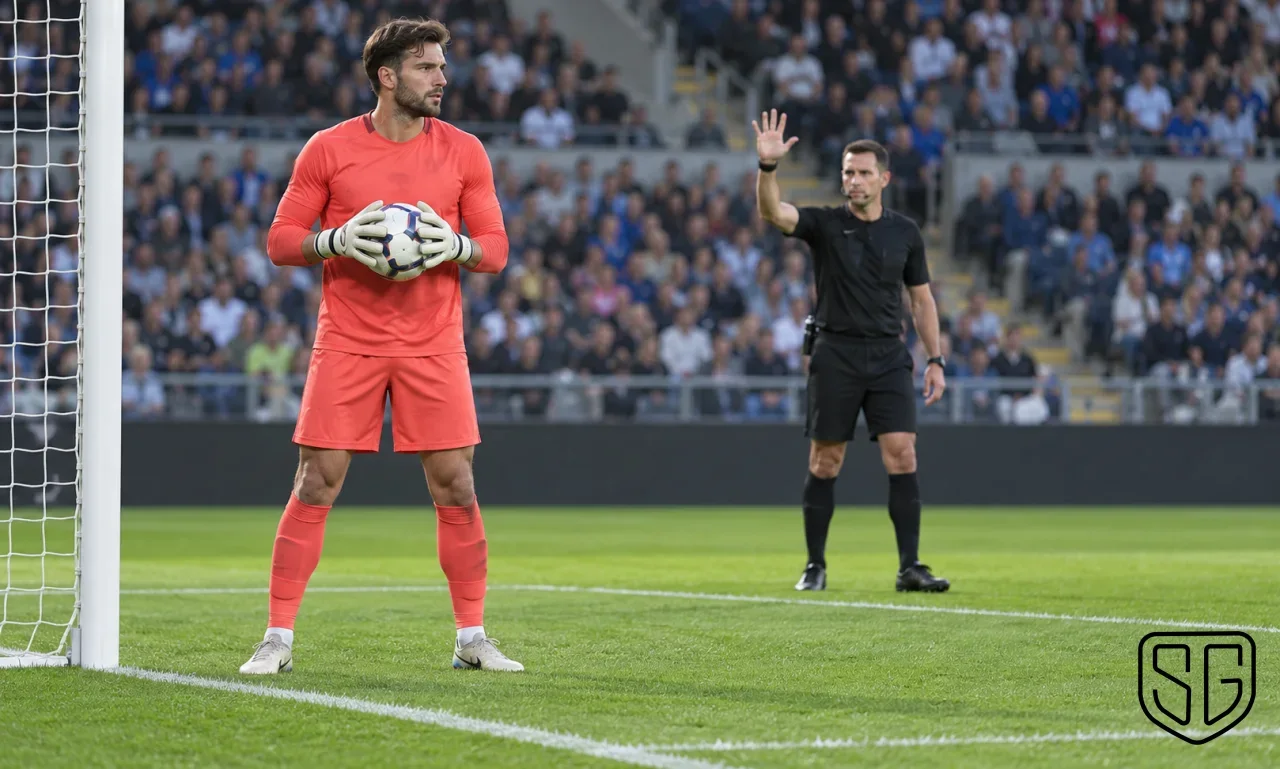
The referee gives a visible warning by raising a hand to count down the final five seconds. The raised hand is therefore not the beginning of a fresh five-second allowance after some separate eight-second count. It is the last part of the same eight-second period. The official decides when control began and uses the signal to help the keeper release the ball in time.
What happens when the time runs out?
If the keeper is still controlling the ball with their hands or arms beyond eight seconds, the referee stops play and awards the opposing side a corner. The choice of corner is based on the keeper's position when penalised, not the spot from which the ball was originally caught. The rule applies even though the ball has not crossed the goal line, which is why the decision can look unusual to viewers expecting a normal corner-kick situation.
There is normally no card for a single breach. IFAB's FAQ says that repeated offences can lead to a caution. It would be misleading to describe every long hold as an automatic booking or to claim the referee must award an indirect free kick: those descriptions confuse the current rule with the previous version.
What if an opponent stops the keeper releasing it?
An attacker cannot challenge a goalkeeper who has the ball under hand or arm control. If an opponent prevents a release and that causes the hold to exceed eight seconds, the referee should not simply penalise the keeper. IFAB says that, unless advantage can be played, play is stopped and a free kick goes to the goalkeeper's team. Whether that free kick is direct or indirect depends on whether the attacker made contact with the keeper. This is different from a keeper holding the ball unimpeded to run down the clock.
The same distinction is useful when a keeper releases the ball before the limit but keeps it at their feet. IFAB's FAQ says the eight-second hand-control offence has ended: play continues and an opponent may challenge for the ball. A separate restriction then matters. If the keeper handles it again before another player has touched it, the decision can be an indirect free kick. Releasing the ball is therefore not a trick that lets the keeper pick it straight back up.
Why did the rule change?
Before the 2025/26 change, Law 12 specified a six-second limit and an indirect free kick as the sanction. IFAB said that was seldom enforced, in part because an indirect free kick inside the penalty area is cumbersome to manage and a very severe opportunity for the opposition. The amended rule allows eight seconds but substitutes a corner kick as the more workable penalty and gives the keeper the referee's visible final-five countdown. The 2025/26 law-change notes explain both the new sanction and the signal.
The practical way to watch an incident is to identify the moment of clear hand or arm control, notice the raised-hand countdown, and see whether the ball is released before the eight seconds end. Do not start the count only when the keeper rises to their feet, reset it on a bounce, or assume every corner awarded after a prolonged hold came from the ball crossing the goal line. And do not confuse this hand-control rule with a goal kick and its separate offside exception: the two restarts have different rules.