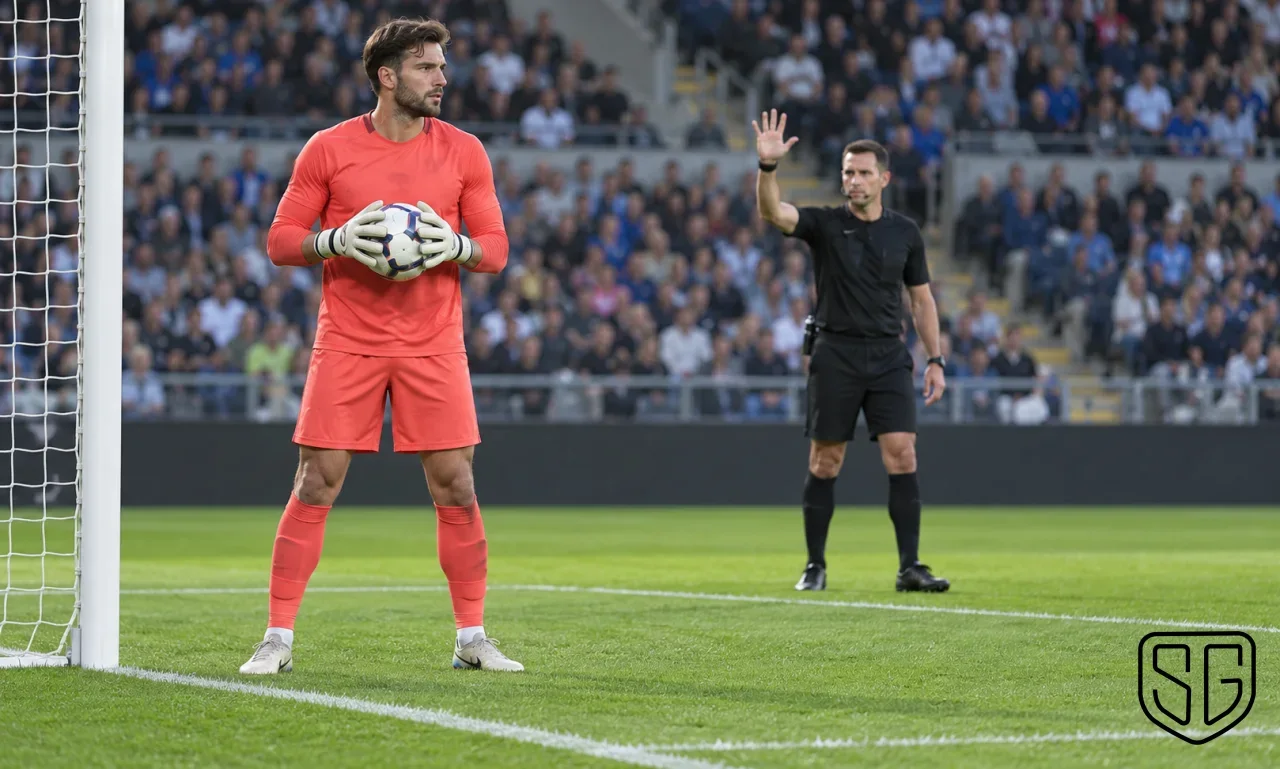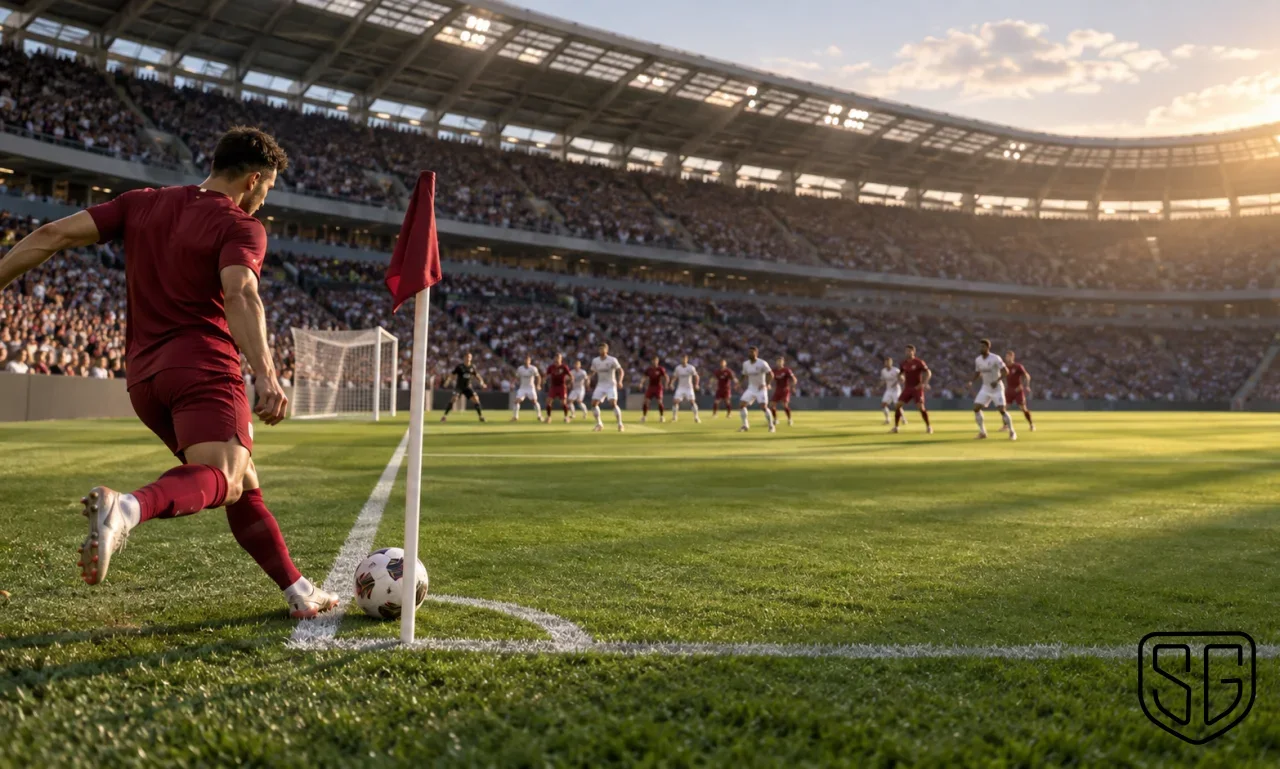
You cannot commit an offside offence by receiving the ball directly from a corner kick. That remains true even if you are closer to the goal line than the defenders when the corner is taken. The exception ends with that direct delivery: a subsequent touch by a teammate can create an ordinary offside decision.
This guide applies the current IFAB Laws of the Game, checked on 17 October 2026. The examples are hypothetical, rather than reports of a particular match. The most useful question when a flag goes up is not simply whether the attack started with a corner, but which teammate last played the ball.
What the law says about the first delivery
IFAB Law 11.3 makes an explicit exception for a player receiving directly from a corner kick. The same provision names goal kicks and throw-ins. A striker may therefore meet a corner at the far post without an offside offence arising from the corner taker's kick, even if the striker's starting position would have looked suspicious during ordinary open play.
This does not mean that players are exempt from every rule while a corner is being taken. Holding, pushing or impeding an opponent can still be penalised. Nor does it mean that offside is switched off until the defending team clears the ball. The exception concerns reception of the original corner delivery, not all later passes in the move.
When can an attacker be offside after a corner?
Imagine the corner is driven into the penalty area, and an attacking player flicks it towards a colleague near goal. The colleague is receiving the flick, not the corner directly. Officials assess their position when the teammate makes that second touch. If they are in an offside position and then become involved in active play, an offside offence is possible under Law 11.2.
A short corner works the same way. The nearby receiver can take the initial pass directly from the corner without committing an offside offence. But when that receiver passes into the area, the positions of the next intended attackers matter at the instant of the new pass. The restart's special treatment does not travel with the ball through an entire passing sequence.
It can even apply to the player who took the corner. In an IFAB Law 11 FAQ, a corner taker passes to a teammate, receives a return ball while offside and plays it. IFAB's decision is an indirect free kick to the defending team. The return pass is a new teammate touch, so being the original kicker offers no protection.
Does a short corner receiver have to be onside?
No. The rule is about receiving directly from the corner, not about whether the receiver is standing in an onside position. IFAB gives a further example in which a nearby player receives the corner while in an offside position, passes to an onside colleague, and that colleague scores. IFAB says the goal stands because the nearby player received the restart directly.
That example also shows why a freeze-frame of the first pass can mislead viewers. Identify the initial corner, then examine each later attacking touch separately. Do not carry a player's position at the corner automatically forward to the second pass: offside position is assessed at the relevant teammate's touch, and being in that position alone is not an offence.
How is the position judged on the next pass?
For an ordinary later pass, Law 11.1 compares an attacker's head, body and feet with both the ball and the second-last opponent in the opponents' half. Hands and arms are excluded. A player level with the second-last opponent is not in an offside position. The test is not simply whether somebody appears to be beyond the goalkeeper: another defender may be the second-last opponent.
Offside position still needs an offence, such as playing the ball or interfering with an opponent, before play is stopped. If an offence does occur, Law 11.4 provides for an indirect free kick where that offence occurred. This is why a flag after a corner does not necessarily contradict the corner exception: the decision may relate to a flick, a return pass or an obstruction during a later phase.
Other corner-kick rules that still matter
IFAB Law 17 says the ball must be placed in the corner area nearest where it crossed the goal line. It is in play once kicked and clearly moves; it need not leave the corner area. Opponents must remain at least 9.15 metres from the corner arc until the ball is in play. The kicker cannot play it again before another player touches it: a second touch brings an indirect free kick, while a handball offence has separate sanctions.
A goal can be scored directly from a corner against the opposing side. That is a different question from whether a team-mate standing near goal was offside on the original delivery. If the delivery reaches that teammate directly, the offside exception applies; if a teammate redirects it first, review the new touch and the receiver's involvement. Other infringements can affect either situation, so a referee's signal should be understood in the full sequence.
The quick answer
Directly from the corner: no offside offence. After another attacking touch: the usual offside law can apply. That distinction covers both a looping cross and a short-corner routine. For the other two restart exceptions, see our guides to offside from a goal kick and offside from a throw-in. They use the same idea of direct reception but involve different restart procedures.