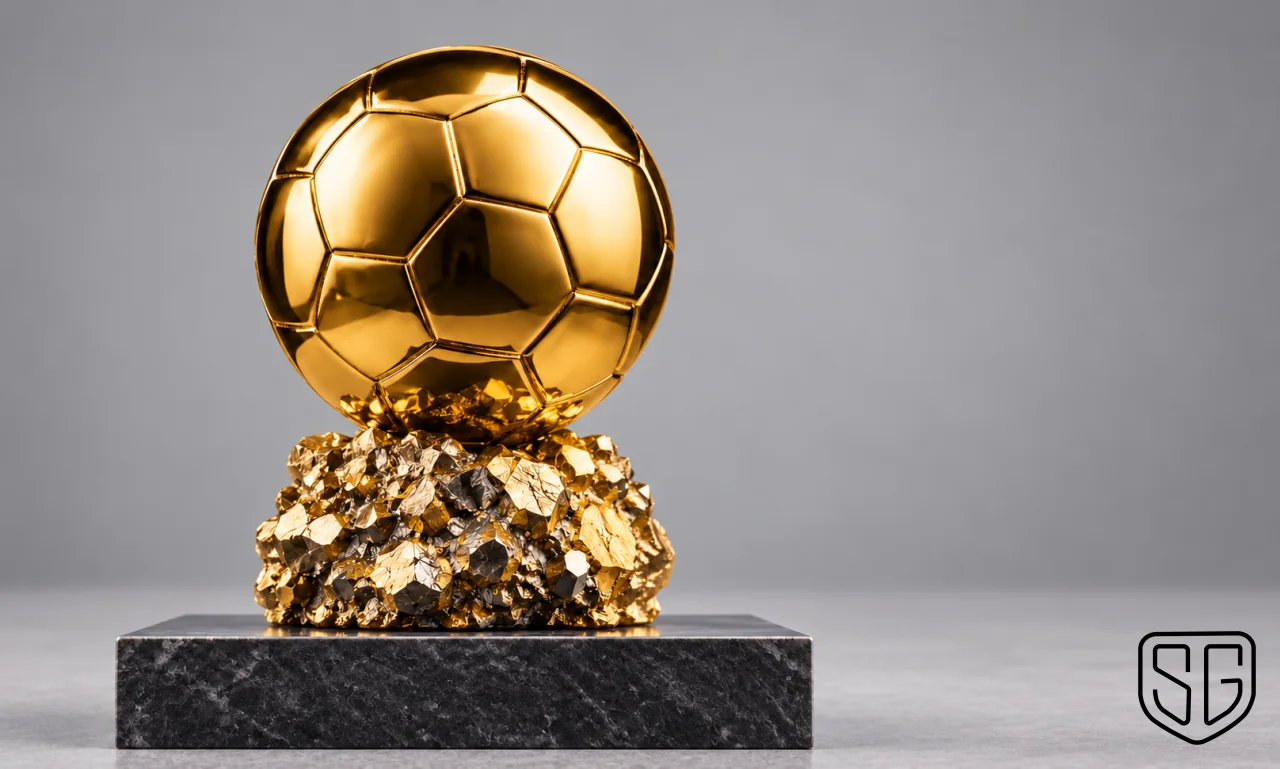
Harry Kane leads SportsGround's four-player Ballon d'Or 2026 power rankings one week before the ceremony, followed by Lamine Yamal, Lionel Messi and Kylian Mbappe. This is our editorial assessment of those four nominees, not an official top four, a leaked ballot or a claim that other candidates cannot win. The central question is whether exceptional scoring should outweigh a World Cup-winning summer or a standout individual international tournament.
UEFA's guide published on 19 October confirms that the awards take place at the London Palladium on Monday 26 October, starting at 20:00 GMT. All four players discussed below are on the official men's shortlist. The final result remains unannounced, so any ordered list before awards night must be read as analysis rather than news of the winner.
The assessment window matters more than October form.
France Football's regulations set the reference period from 3 August 2025 to 19 July 2026. The criteria prioritise individual performance, followed by team achievements and trophies, then sporting conduct. That ordering informs our preference for Kane's sustained output, although it does not prescribe how every journalist must balance a striker against a midfielder.
The organiser has also explicitly clarified that the beginning of the current season does not count. A brilliant October goal, a new club's winning run or a recent international performance can keep a name in public discussion without belonging to the eligible record. Our comparison therefore excludes those later matches. A fan poll is likewise not evidence of the jury's voting intentions.
1. Harry Kane: the strongest scoring argument
Bayern's Golden Shoe announcement on 26 May records 36 Bundesliga goals and 61 goals in 51 appearances across all club competitions in 2025/26. It also confirms Bayern's league and DFB Cup double. Those are separate statistical scopes: the league figure should not be added to the all-competition total, and neither number is a club-and-country tally.
Our judgement is that this combination gives Kane the clearest case among the four assessed here. He is not relying solely on a short burst at one tournament, nor on goals detached from team success. The limitation is equally clear: scoring dominance does not settle a multi-criteria award automatically. A juror placing greater emphasis on the summer's biggest international tournament could reasonably prefer someone else.
2. Lamine Yamal: a World Cup winner in the attacking mix
Barcelona confirms Yamal among its eight Spain World Cup winners. That achievement belongs within the assessment window and is relevant to the team-success criterion. His nomination is confirmed independently by UEFA. It is unnecessary to borrow performances from the new campaign to justify discussing him before the ceremony.
We place Yamal second in this editorial comparison, behind Kane's exceptional club scoring. A World Cup-winning attacking player presents a different case from a centre-forward whose strongest numerical evidence comes from his club season. The order reflects our chosen balance between those arguments, not information about the jury's ballot.
The qualification matters: a winner's medal establishes collective success, but does not independently rank every contribution within that team. His age and potential should not substitute for the eligible campaign either. Supporters can make a strong case for him without presenting future greatness, recent club form, or a fan poll as evidence that the official result is settled.
3. Lionel Messi: tournament impact, not a career award
Messi takes third in our revised editorial order. The Asian Football Confederation's World Cup report records his eight goals at the 2026 finals, behind Mbappe's ten. FIFA's tournament awards summary also lists Messi as the Silver Ball recipient. These are tournament-specific achievements, not club-season statistics.
That individual recognition gives his candidacy substance beyond his name or previous Ballon d'Or victories. Our reasoning is that the combination of scoring and tournament performance merits a place in this selected group. It does not require treating the award as a tribute to his whole career: the question is what he produced during the stated reference period.
His eight goals should not be confused with a career World Cup total, and later MLS matches cannot be added to the eligible record merely because they happened before the ceremony. Messi's case can be discussed seriously while retaining those boundaries. Third place here is SportsGround's preference, not an official prediction based on access to voting figures.
4. Kylian Mbappe: the World Cup's leading scorer
FIFA's awards report confirms Mbappe scored ten goals in eight matches to win the 2026 World Cup Golden Boot. That gives him a clearly defined individual achievement within the relevant period. It is a tournament scoring award, separate from Bayern's European Golden Shoe evidence for Kane and separate again from the Ballon d'Or itself.
We put Mbappe fourth in this four-player comparison, behind Messi, while recognising that a goals-first assessment of their World Cup campaigns could reverse that order. The ranking is not obtained by arranging their tournament totals alone. It expresses a broader editorial judgement and should remain open to disagreement rather than being dressed up as a statistical certainty.
His inclusion also keeps the distinction between individual and collective achievement visible. A player does not need to win every competition to deserve consideration, just as a champion does not automatically lead every individual ranking. The official jury must weigh the eligible record; this article explains our preferred order without claiming to reproduce theirs.
Who else is in contention?
The shortlist also includes Rodri, Ousmane Dembele, Michael Olise and many others. This focused comparison is not a full projected ballot. Our complete nominees guide covers the field, while the ceremony guide covers event arrangements. Until the official announcement, a clear distinction between verified achievements and editorial preference is more useful than presenting any power ranking as settled fact.