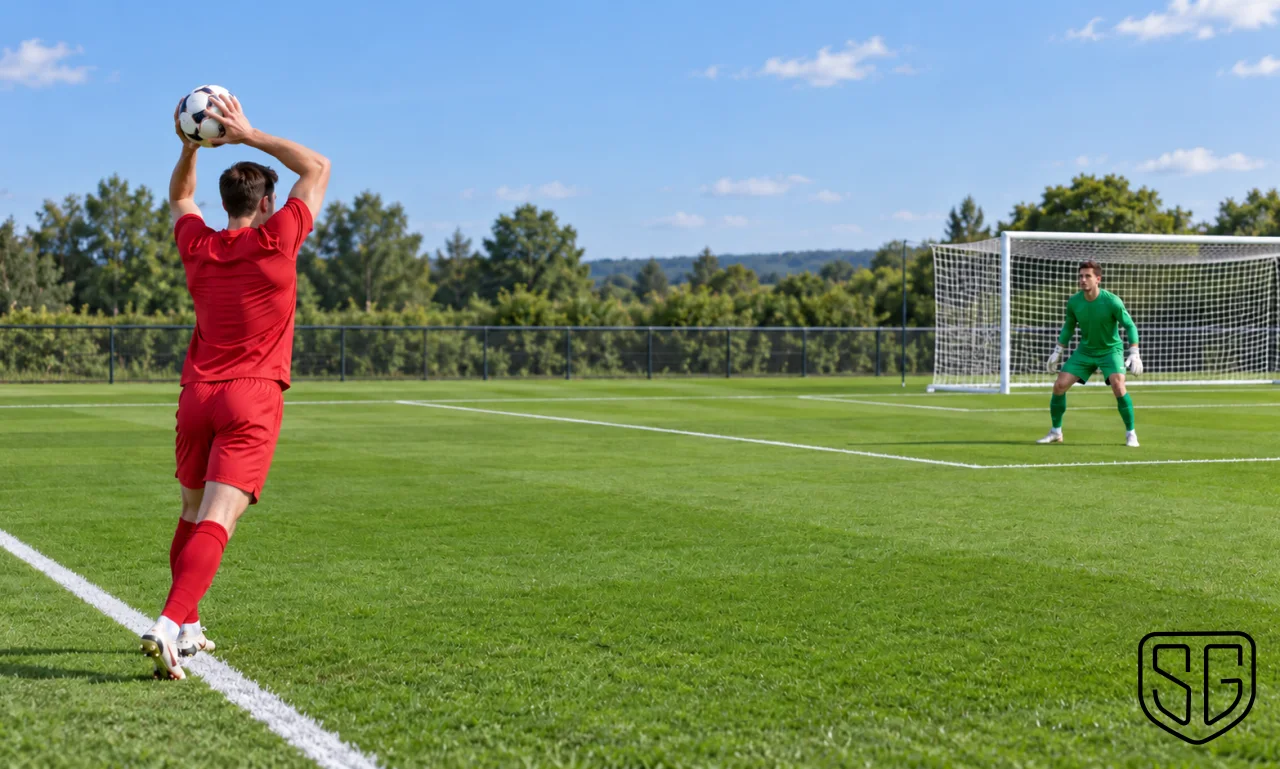
A goalkeeper cannot pick up the ball inside their own penalty area after receiving it directly from a throw-in taken by a team-mate. The normal sanction is an indirect free kick to the opponents, rather than a penalty. This restriction appears in IFAB Law 12 for 2026/27 and is also addressed in the official Law 15 questions and answers.
The goalkeeper is still allowed to receive the throw. The important distinction is between receiving the ball and handling it. Using the feet to control or pass it is permitted; catching it directly from the team-mate's delivery is the action the rule restricts. A throw back towards the goalkeeper is therefore a passing option, not an automatic stoppage.
What counts as receiving directly?
Imagine an illustrative situation in which a defender takes a throw-in beside their own penalty area. The goalkeeper waits inside the area and catches the incoming ball without another player touching it. The referee awards the opponents an indirect free kick. The decision is the same if the ball bounces on the grass before the goalkeeper gathers it: a bounce is not a touch by another player.
A goalkeeper should not assume that cushioning the delivery with a foot creates a new phase that permits an immediate pick-up. The relevant exception in Law 12 concerns a clear attempt to kick the ball to release it into play. Merely trapping it to make a catch easier is different from that attempt. Referees must judge what actually happened, rather than treating every contact with a boot as an exception.
The attempted-kick exception
Law 12 allows handling after the goalkeeper has clearly kicked, or attempted to kick, the ball to release it into play. This can matter when a goalkeeper tries to clear a team-mate's throw-in but mishits it. The provision is about the clear kicking action, not a general permission to catch any difficult pass. The law sets out that exception alongside the handling restrictions.
For players, the practical approach is to make the intended clearance obvious and communicate before the throw. A thrower can deliver towards the goalkeeper's feet and leave enough space for a return pass. Throwing towards the hands under pressure creates an avoidable problem. These are training suggestions for managing the situation, rather than additional conditions written into the law.
Where is the free kick taken?
Law 13 governs the location and procedure for the resulting indirect free kick. Normally it is taken where the handling offence happened. If an attacking team is awarded an indirect free kick inside the opponents' goal area, it is moved to the nearest point on the goal-area line parallel to the goal line. That special location can put several defenders close to their goal.
The referee signals an indirect free kick with a raised arm. The ball must touch another player before a goal can be scored from it. The goalkeeper's handling offence within their own penalty area does not itself require a caution or sending-off. Outside that area, the goalkeeper is subject to the ordinary handball restrictions, so the decision can be different.
Do not confuse this with other goalkeeper rules
A throw-in from an opponent does not fall under the team-mate restriction, although other laws still apply. A team-mate's deliberate kick to the goalkeeper has its own restriction in Law 12. Neither should be confused with a dropped-ball restart, where a goalkeeper may pick up the ball in their penalty area once it is in play. Identifying the preceding action is essential.
There is also a separate limit on how long a goalkeeper may control the ball with their hands or arms. SportsGround's eight-second goalkeeper guide explains that rule. The offside exception for a direct throw-in answers another common question. A delivery can be exempt from offside while still leaving the receiving goalkeeper unable to catch it: the two rules govern different actions.