You cannot be in an offside position while entirely in your own half when a team-mate plays the ball. However, you can commit an offside offence after running back into your own half from an offside position. That distinction explains why a referee may award the other team a free kick on your side of the halfway line. The relevant rules are in IFAB Law 11 for 2026/27.
The simplest way to follow an incident is to separate two questions: where was the attacker when the team-mate played the ball, and where did the attacker subsequently become involved? They are different moments. Looking only at the position where a player eventually receives a pass can produce the wrong answer.
Position is judged before the reception
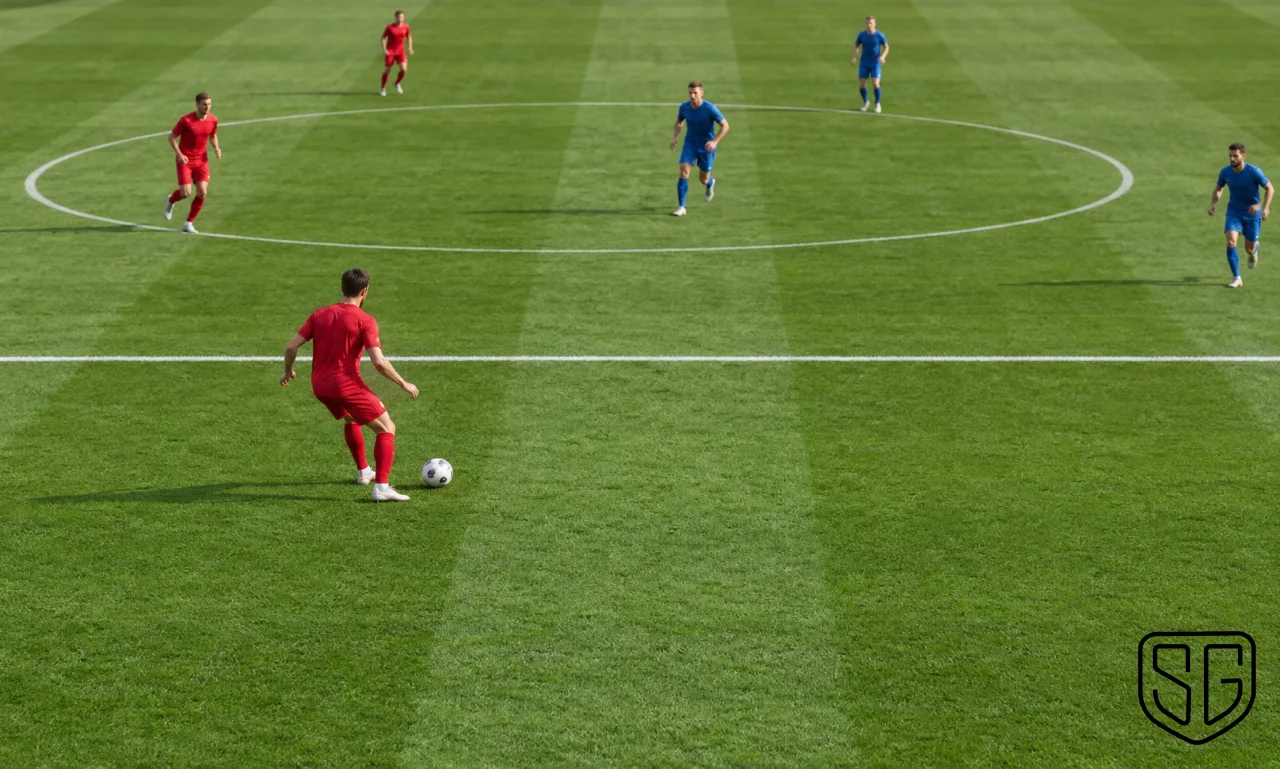
Consider an illustrative counter-attack. A red-shirted forward is a metre inside their own half when a red midfielder passes forward. The forward then runs across halfway and collects the ball behind the blue defence. Starting that run from their own half means the forward was not in an offside position at the relevant moment. Reaching the ball in the opponents' half does not retrospectively change the earlier position.
Now reverse the movement. The forward starts beyond halfway, nearer the opposing goal line than both the ball and the second-last opponent. A team-mate plays towards them, and they run back across halfway to receive it. That return does not erase the original offside position. If they play the ball, an offside offence can occur in their own half. IFAB explicitly addresses this returning-attacker situation.
What the halfway line means
The halfway line itself is excluded from the opponents' half for offside positioning. Relevant parts are the head, body and feet; hands and arms do not count, including a goalkeeper's. An outstretched arm beyond the line therefore does not, by itself, put a player in an offside position. A foot extending beyond it may change that assessment. Being level with the second-last opponent or with the ball is also different from being nearer the goal line than both.
For a spectator, a useful habit is to identify the halfway marking first, then locate the relevant players at the instant of the pass. A television camera moving with the attack can make a player appear to have started farther forward than they did. A still image of the reception answers a different question from a still image of the pass.
Why the free kick can be in your half
Law 11 places the indirect free kick where the offside offence occurs, expressly including a player's own half. That is why the restart location alone cannot tell you whether the original positional judgement was correct. The attacker may have been in the opponents' half at the first moment and in their own half when they touched the ball.
Law 13 explains indirect free kicks: the referee raises an arm to indicate the restart, and a goal cannot be scored unless the ball subsequently touches another player. The signal helps distinguish this restart from a direct free kick for an unrelated foul. A defender winning possession or a separate foul can require another decision, so the entire sequence matters.
Do restart exceptions change the answer?
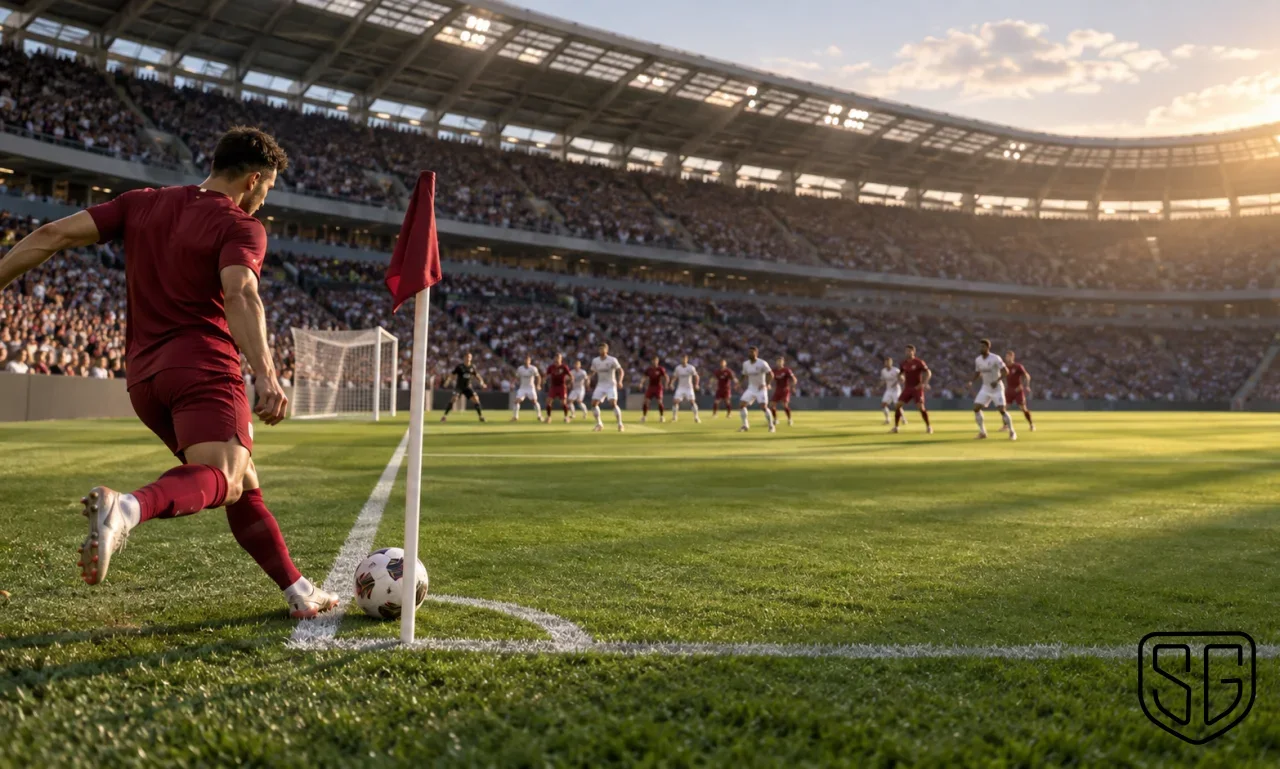
Yes, the type of delivery matters. Receiving directly from a throw-in, goal kick or corner kick is exempt from offside. That is a separate exception from the own-half test. For example, a player receiving a team-mate's throw-in directly is not penalised simply because they waited beyond the defensive line. Law 15 covers throw-ins, while Law 16 covers goal kicks.
Our guides to offside from a throw-in and offside from a goal kick explain those deliveries. For ordinary open-play passes, keep following the two moments: the initial position and the later involvement. A player starting legally in their own half may run forward; a player starting offside cannot cure that position merely by running back to collect the same pass.