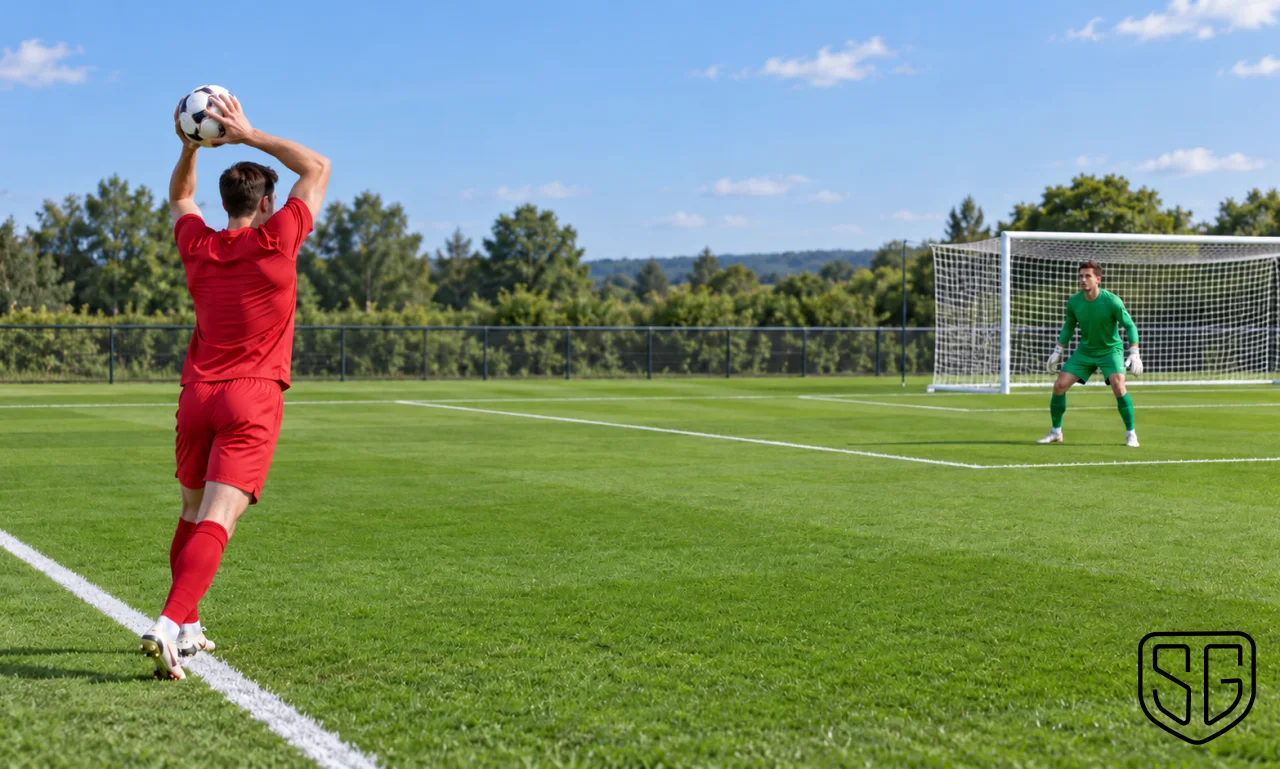
You cannot score directly from a throw-in. If a correctly taken throw travels into the opponents' goal without touching another player, the restart is a goal kick. If it enters the thrower's own goal untouched, the opponents receive a corner. IFAB Law 15 for 2026/27 sets out both decisions, so the direction of the throw matters even though neither outcome is a goal.
The crucial word is directly. A long throw can certainly lead to a goal, but someone else must touch the ball before it enters the net. That contact might be an attacking header, a defender's attempted clearance or a goalkeeper's fingertips. The referee must still consider any other offence before awarding the goal.
What happens if nobody touches the ball?
Imagine a hypothetical throw towards a crowded penalty area. An attacker swings at the delivery but misses, the goalkeeper is distracted and the ball goes into the net. There is no goal because an attempted touch is not an actual touch. Law 15's official questions and answers address this kind of incident. A convincing celebration or the goalkeeper's reaction cannot replace evidence of contact.
A bounce on the grass does not count as another player's touch. Neither does a rebound from a goalpost or the crossbar. If a legal throw bounces twice and crosses the opponents' goal line between the posts, it remains a direct throw-in for this purpose. The referee awards the goal kick rather than treating the bounce as a new attacking action.
Does a goalkeeper's touch change the decision?
Yes. Suppose the defending goalkeeper reaches for the incoming throw and brushes it with a glove before it enters their goal. It is no longer entering directly from the throw-in, so a goal may count if the rest of the incident is legal. Whether the contact was a save attempt or a mistake does not restore the direct-scoring prohibition.
There is a different handling restriction when a goalkeeper receives their own team-mate's throw. Law 12 restricts handling a direct team-mate throw-in inside the goalkeeper's penalty area, subject to its attempted-kick exception. SportsGround's goalkeeper throw-in handling guide explains that separate issue. It should not be confused with the rule governing a throw towards the other team's goalkeeper.
What if a throw goes backwards into your own net?
An untouched throw back into the thrower's goal produces a corner for the other team. Consider an illustrative misunderstanding between a defender and goalkeeper: the goalkeeper moves away, the defender throws towards the goal and neither makes another contact. Despite the ball crossing the goal line, Law 15 expressly prevents a direct own goal from that restart.
If the goalkeeper or another player touches the ball first, that specific exception no longer describes the incident. The referee then evaluates the subsequent play, including any handling offence. This is why checking the last touch is essential: two deliveries with almost identical paths can require different decisions because one goalkeeper made contact and the other did not.
The throw itself must be legal
The throw-in procedure requires a two-handed delivery from behind and over the head, with part of each foot on the touchline or on the ground outside it. The ball enters play when it enters the field. A delivery that is incorrectly taken can require a throw to the opponents, rather than a decision based only on its eventual arrival in the net.
The thrower also cannot immediately play their own delivery again before another player touches it. Throwing the ball a short distance, running onto it and shooting is therefore not a way around the direct-goal rule. Identify the restart, whether it was properly taken and who next touched the ball before judging the finish.
How does offside fit into a long throw?
Law 11 exempts direct reception from a throw-in from offside. A forward can receive that delivery beyond the defensive line, but the exemption does not mean the ball can go straight into the goal untouched. Our throw-in offside explanation separates those questions. Once a team-mate plays the ball again, ordinary offside assessment applies to the next phase.