Quiet indoor football training starts with an honest limitation: no ball exercise can be guaranteed silent. Sound can travel through floors and walls even when the contact seems soft to you. If people nearby need quiet, the considerate choice may be a no-ball activity or postponing ball work until you have a suitable outdoor space.
This guide offers original low-impact practice ideas, not acoustic advice or a promise that a mat will soundproof a room. Check household permission, building rules and the people who might be disturbed. A room that looks large enough for a few touches is not automatically suitable for football practice.
Check the room before touching the ball
Clear your route and the area a missed touch could reach. Keep away from stairs, windows, screens, pets and other people. Check that your footwear grips the surface. Do not practise in socks on a slippery floor or assume a rug is secure simply because it feels soft.
Ask somebody in the room below or next door whether they can hear a very gentle test movement, if that is practical and welcome. If it is disruptive, stop. Do not keep increasing layers of loose fabric under the ball; an unstable surface creates a different problem and does not establish that noise has been controlled.
Remove the main impact actions
Leave out shooting, wall passing, juggling, bouncing and rapid foot stamping. Even a deliberately weak kick can send the ball into something fragile. Do not use furniture as a rebound surface or a closed door as a target. Indoor permission for a slow roll is not permission for a passing session.
A soft ball may behave differently from a normal football and can still cause disturbance. Use equipment only in a way appropriate to the room and its intended use. Do not deflate a match ball beyond its manufacturer's guidance simply to make it quieter, or claim that a substitute ball provides identical feedback.
Try a slow sole roll only where suitable
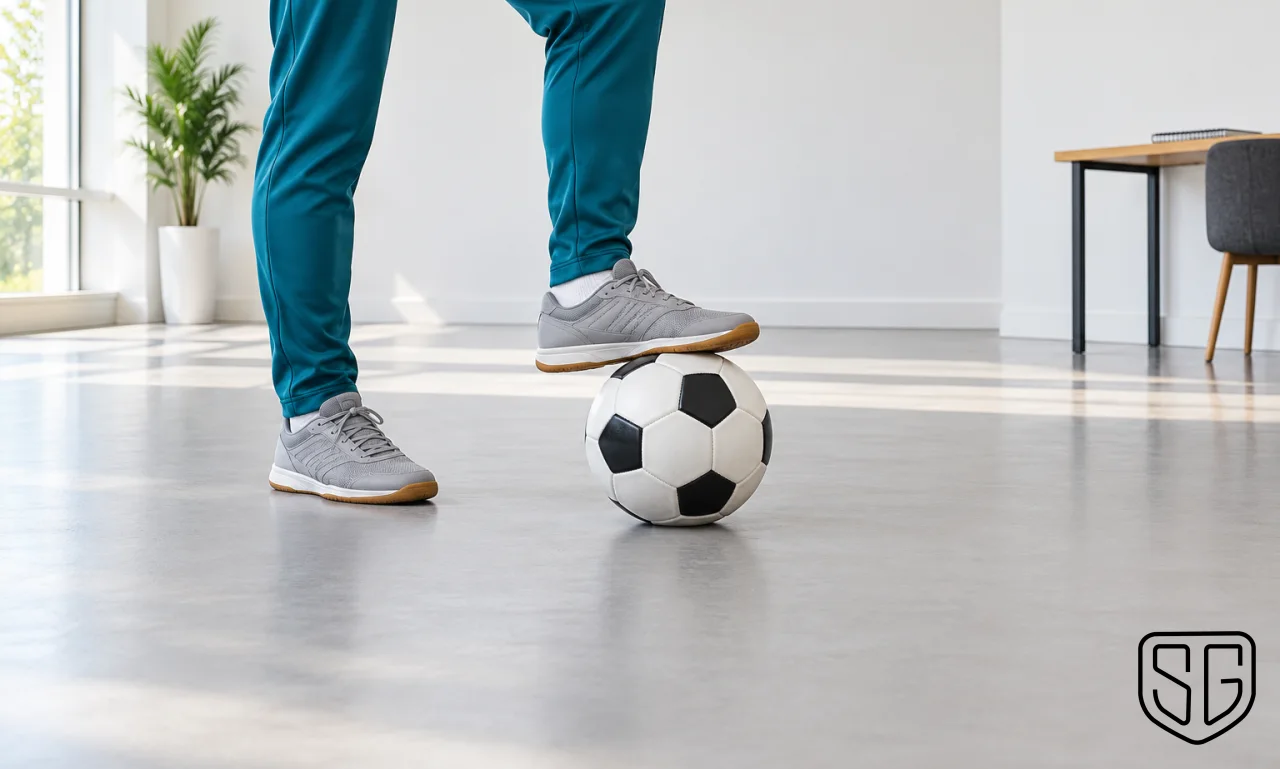
On a permitted, stable, nonslip surface, gently roll the ball a short distance with the sole and bring it to rest. Keep both your steps and the ball on the floor. Pause fully, then mirror the movement. The task should remain slow enough that you can stop without an urgent extra step.
The FA's ball-mastery guidance, dated August 2023, includes exploration of touch and manipulation for young players. It does not certify an indoor room or establish a quietness threshold. Treat this as a restricted opportunity to feel the ball, not a replacement for travelling, receiving passes or playing against opposition.
Use a stop-and-reset sequence
If the first task is genuinely acceptable to others, make a small inside-foot adjustment, settle the ball and reset your position. Avoid quick alternating taps. Choose a generous stopping area so a modest error does not reach furniture. If the ball regularly escapes that area, remove ball work rather than shrinking the margins around hazards.
Our small-bedroom practice guide considers limited-space organisation more broadly. Here, noise is an additional constraint, so even an exercise that fits physically may be inappropriate. Do not interpret completing a few quiet contacts as permission to continue when somebody says the activity is disturbing them.
Switch to useful no-ball work
Sit down and review a short sequence from a match you can legally watch. Pause before the player receives and identify a possible passing option, then watch what happens. Describe what information was visible rather than declaring the player wrong from a single camera angle. This is observation practice, not evidence that your own scanning has improved.
You can also plan the next outdoor session, record a recent difficulty or sketch two possible receiving directions on paper. The FA's April 2023 observation guidance recommends a clear focus and simple notes. Applying that principle to your own review gives the quiet period a purpose without pretending it supplies physical repetitions.
Know what to practise elsewhere
Keep a short list of the actions that the room cannot support: moving onto a pass, controlling a firmer delivery or responding to a defender. Take those priorities to a suitable pitch, sports hall or coached session. Do not try to compensate for a quiet indoor session by rushing through risky movements at the end.
The FA practice spectrum explains that technique exercises and realistic play offer different learning opportunities. Quiet floor-level work is narrower still. A successful indoor session respects the space and people around it; sometimes the best decision is to leave the ball still and save practical training for another setting.