Training for football in a small bedroom should mean gentle, stationary ball work, not trying to recreate a pitch between the bed and wardrobe. If there is no clear non-slip space where you can move your feet and stop safely, choose a different location or practise planning and observation without a ball.
The room sets the limit. A ball striking a screen, a loose rug sliding or a foot catching a bed frame can end a session before anything useful happens. Get permission from the person responsible for the space and keep others, including anyone opening the door, out of the practice area while you are moving.
Make a genuine space check
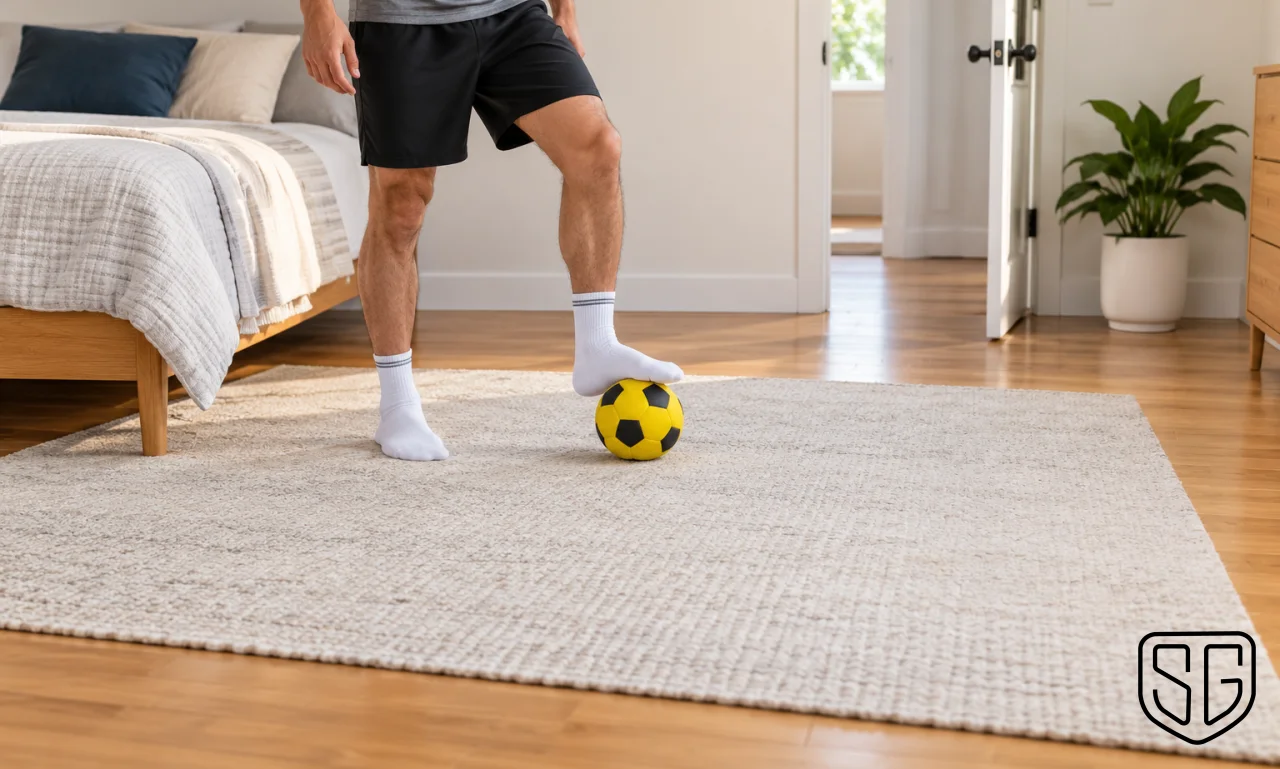
Clear loose objects, cables and anything breakable. Check that your chosen surface and footwear provide dependable grip. Do not assume socks on a smooth floor are suitable. A rug must not slide or bunch under your support foot. Keep a clear route out of the room rather than boxing yourself between furniture.
Use a soft ball appropriate to the room where possible. It will behave differently from a normal football on grass, so treat the session as coordination work rather than a test of match passing weight. Do not deliberately deflate a match ball and assume the resulting touch will transfer unchanged outdoors.
Keep the ball on the floor
Begin with the ball stationary. Rest one sole lightly on top, roll it a small distance and bring it back without leaning heavily on it. Keep the supporting knee comfortable and the body balanced. Change feet after a few controlled attempts. This is a gentle movement, not a jumping or balancing-on-the-ball exercise.
Next, use the inside of one foot to move the ball across to the other. Make the travel distance small enough that neither foot reaches towards furniture. Pause whenever the ball drifts out of the clear patch. The boundary is a reason to reset, not an invitation to stretch awkwardly after it.
A short suggested session
Try one minute of gentle movement without the ball to confirm the space feels suitable. Follow with thirty seconds of slow sole rolls, a pause, then thirty seconds of inside touches. Repeat once if comfortable. Finish by combining a roll and a stop on each foot, leaving time to tidy away afterwards.
These timings are an optional starting structure, not a prescribed training dose. Make the work shorter if concentration or control fades. Stop for discomfort rather than using the room's small size as a reason to continue through it. Children should have an adult check that the location and activity are suitable.
What not to attempt indoors
Avoid shooting, lofted passes, heading, rapid spins, jumping toe taps and rebounds against bedroom walls. Beds and wardrobes are not training obstacles. Even a soft ball can knock something over, and a hard rebound gives you little time to react in a cramped area. Save travelling dribbles and power work for a suitable outdoor space.
Noise matters too. A routine that repeatedly disturbs people below or next door is not a workable home plan. Discuss a suitable time and stop if the arrangement is not acceptable. Quiet control is a useful restriction, but it should not be presented as proof that the session is risk-free.
Connect the session to football
The FA ball-mastery guidance explains that manipulating the ball supports actions such as dribbling, turning and receiving. In a bedroom, you are practising a small part of those actions. Focus on how softly you move the ball and whether the supporting leg stays steady, rather than trying to achieve match speed.
The practice spectrum also separates repetition from applying technique against opposition. Bedroom work cannot replace games or coached practice. Use our first-touch training guide for receiving ideas in a more suitable space. Before your next outdoor session, choose one movement from the room to repeat with proper travelling distance and room to stop.