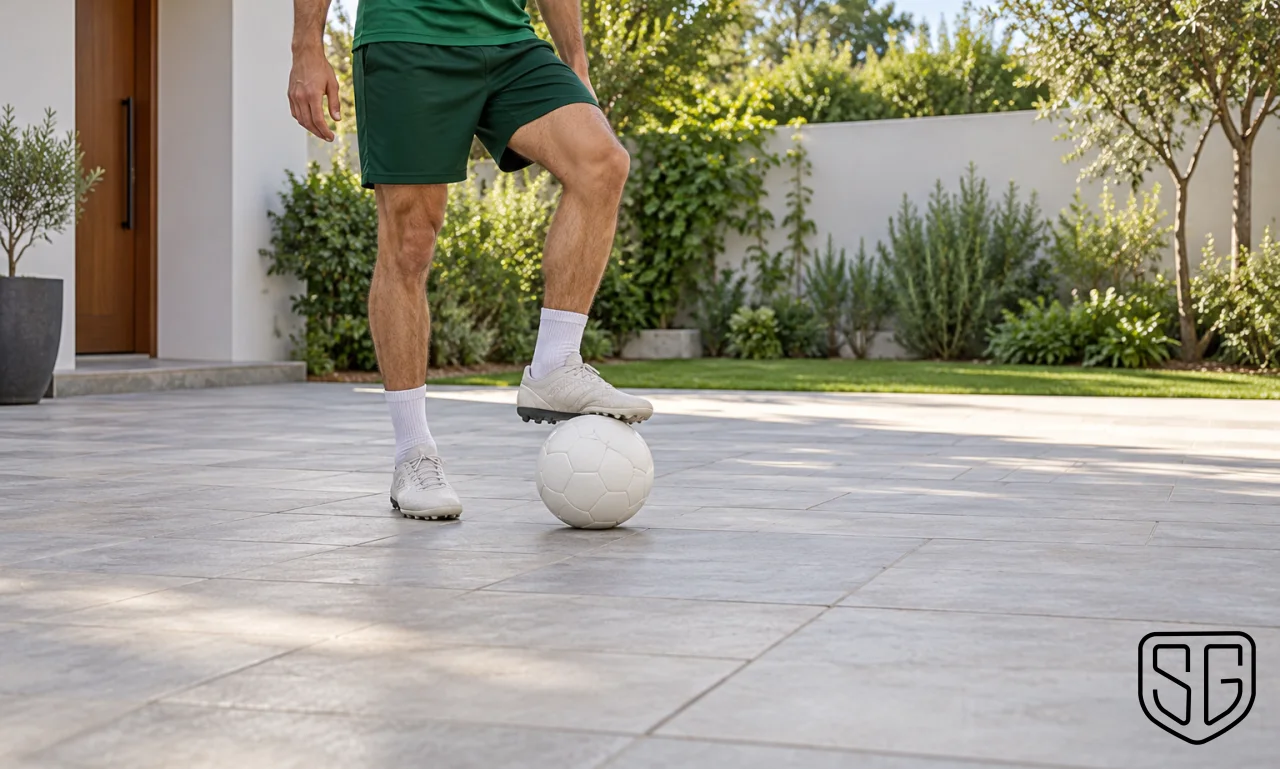
These football drills at home without cones use a ball and a clear practice area. You do not need an obstacle course to work on touch, balance and changes of direction. The aim is to choose a few movements you can perform carefully, rather than rushing through fifteen exercises just to finish a list.
The following is an original suggested practice menu, not an official federation programme. England Football Learning describes ball mastery as manipulating the ball in different directions and at different speeds. These activities explore that idea with simple constraints. Use suitable footwear, a non-slip surface and permission to practise; avoid hard shooting around homes.
Start with stationary control
- Inside touches: move the ball gently between the inside of both feet. Keep it beneath your body rather than chasing it sideways.
- Sole rolls: roll the ball across with one sole, then stop it with the other. Transfer your weight before changing feet.
- Pull and stop: draw the ball backwards with the sole and stop it nearby. Do not lean so far back that balance disappears.
- Outside and return: nudge the ball out with one foot's outside edge, then bring it back with the inside. Repeat slowly on each side.
- Quarter turns: use several tiny touches to turn through a right angle. Pause in balance before making the next turn.
Add a short route
- Walk and freeze: dribble for a few walking steps, then stop the ball under control. Choose a shorter route if the space is tight.
- Two-touch travel: alternate feet as you move across a safe strip. The challenge is an even rhythm, not speed.
- Return journey: travel out gently, turn with the sole and come back. Leave room to stop before the boundary.
- Diagonal touches: move forward slightly left, then slightly right. Keep the ball close enough to change direction without reaching.
- Slow-fast-slow: change from very gentle to slightly quicker touches and back. Use this outdoors only where the stopping space is adequate.
Introduce a decision
- Colour call: name a visible safe landmark before turning towards it. Never use fragile furniture as an obstacle.
- Look and stop: briefly look ahead between touches, then freeze the ball. Keep each glance short enough to retain control.
- Different exits: after three touches, choose a new direction. Avoid repeating the same exit automatically.
- Foot switch: use the less comfortable foot for the return leg of a route. Slow down rather than compensating with bigger touches.
- Combination round: link a sole roll, inside touch and turn. Restart calmly if the sequence breaks instead of forcing the next movement.
Build a session from the menu
Choose two stationary drills, two travelling drills and one decision exercise. As a starting example, try each for thirty seconds, take time to reset, and repeat only while the movements remain controlled. There is no requirement to complete every drill, and a small room may suit only the stationary choices.
Keep a simple record of clean attempts and boundary escapes. If inside touches are tidy but turns repeatedly run away, give the turns more attention next time. This produces a useful reason for choosing exercises rather than treating the number of touches as the only measure that matters.
Know what solo practice cannot supply
The FA practice-spectrum guidance distinguishes technical repetition from using skills in realistic football situations. A living-room routine does not provide a defender's pressure, a team-mate's movement or the choices of a match. Use safe home practice as a supplement, then test those movements in suitable games when opportunities arise.
For receiving work rather than a general exercise menu, use our first-touch training guide. Keep the next session focused on one detail you noticed today: a gentler touch, a steadier support foot or a calmer turn. Progress is individual, so this menu makes no promise of a particular improvement within a fixed number of days.