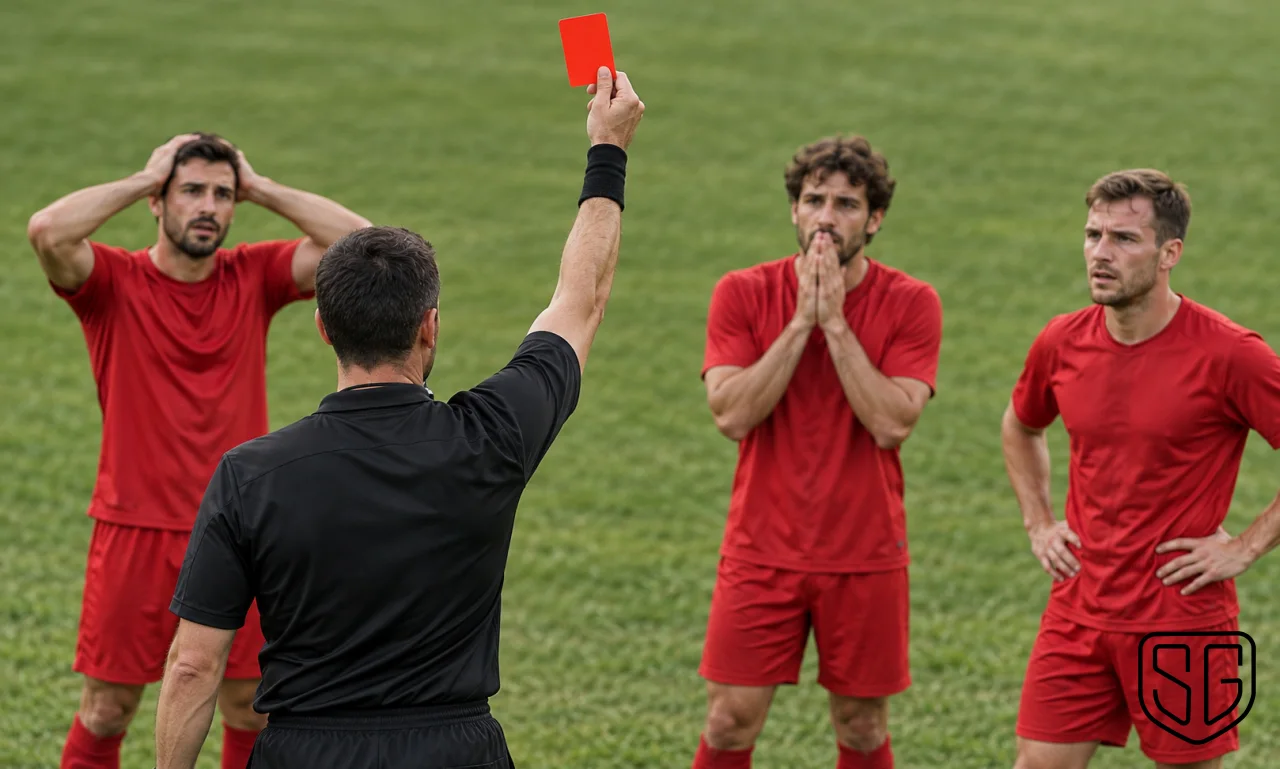
Yes, a football match can end early because of red cards if a team is left with fewer than seven players. IFAB Law 3 sets that minimum for the standard eleven-a-side game. A dismissal does not automatically end the match, but enough on-field dismissals can leave the referee unable to continue it.
The number of red cards shown is not always the same as the number of players lost from the side on the field. A substitute or coach can be sent off without reducing the playing eleven. Existing injuries, a team starting short and the timing of a dismissal can also change how quickly the minimum is reached.
How many dismissals would take eleven below seven?
A team starting with eleven on-field players can lose four to dismissals and still have seven. A fifth such dismissal would leave six, below the normal minimum. This is arithmetic applied to that starting situation, rather than a universal rule that a referee must wait for the fifth red card in every match.
For example, imagine a hypothetical side that begins with ten eligible players. If four of those players are later dismissed, six remain. The minimum has been breached even though the team has not received five on-field red cards. Equally, a side already reduced by an unavailable injured player may reach the threshold through a different combination of events.
Why do red cards to the bench not count the same way?
Law 3 distinguishes a player who is sent off after kick-off from a named substitute who is dismissed. The former cannot be replaced, while the latter loses their place among the available substitutes. Sending off a coach does not require the team to nominate an on-field player to leave as well.
Suppose an illustrative game has four red cards: two to players, one to a substitute and one to a coach. A team that started with eleven still has nine players, assuming no other reduction. Headlines reporting 'four sent off' can therefore be accurate about disciplinary incidents while giving an incomplete picture of the team's playing strength.
Does a dismissal before kick-off have the same effect?
Not necessarily. A named starter dismissed before kick-off can be replaced by a named substitute under Law 3, although that substitute's vacated place cannot be filled. Our pre-match sending-off guide explains the timing. A red card before the opening whistle does not always mean the team begins with ten.
When reviewing whether a match can continue, begin with the actual authorised players available at that point. Do not subtract every red card graphic from eleven without checking who received it and when. The referee's team list and disciplinary record provide the factual sequence needed to apply the minimum-player requirement.
Can the referee allow an attack to finish?
Law 3 provides a specific situation where a player deliberately leaves the field and the team drops below seven: the referee need not stop immediately if advantage can be played, but the match must not resume after the ball next goes out if the minimum is still absent. That narrow provision is not a general exception for continuing with six after dismissals.
Current rules also distinguish certain temporary absences under approved protocols from permanent reductions. A player briefly off for a prescribed treatment or substitution procedure should not automatically be counted as though they had been sent off. Law 5 places responsibility on the referee to apply the relevant laws and control whether play continues.
Is the score automatically recorded as 3-0?
No universal 3-0 score follows from the basic minimum-player law alone. Law 7 addresses abandoned matches and says, in principle, that a team responsible for abandonment through having fewer than seven forfeits. The competition's regulations and organisers determine how that is implemented, including the recorded outcome.
This separates the referee's decision that play cannot continue from the administrative decision about the result. Law 10 describes how a normal completed match is decided, but an abandoned fixture can require the competition's own process. Without checking those regulations, nobody should promise a replay, a particular score or a points deduction.
For spectators, the useful questions are how many players remain, whether the absences are permanent, who received each dismissal and what the competition regulations say. Red cards can end a match early, but the card total alone is not the complete test. These hypothetical examples explain IFAB's current rules checked on 21 October 2026, not any specific disciplinary case.