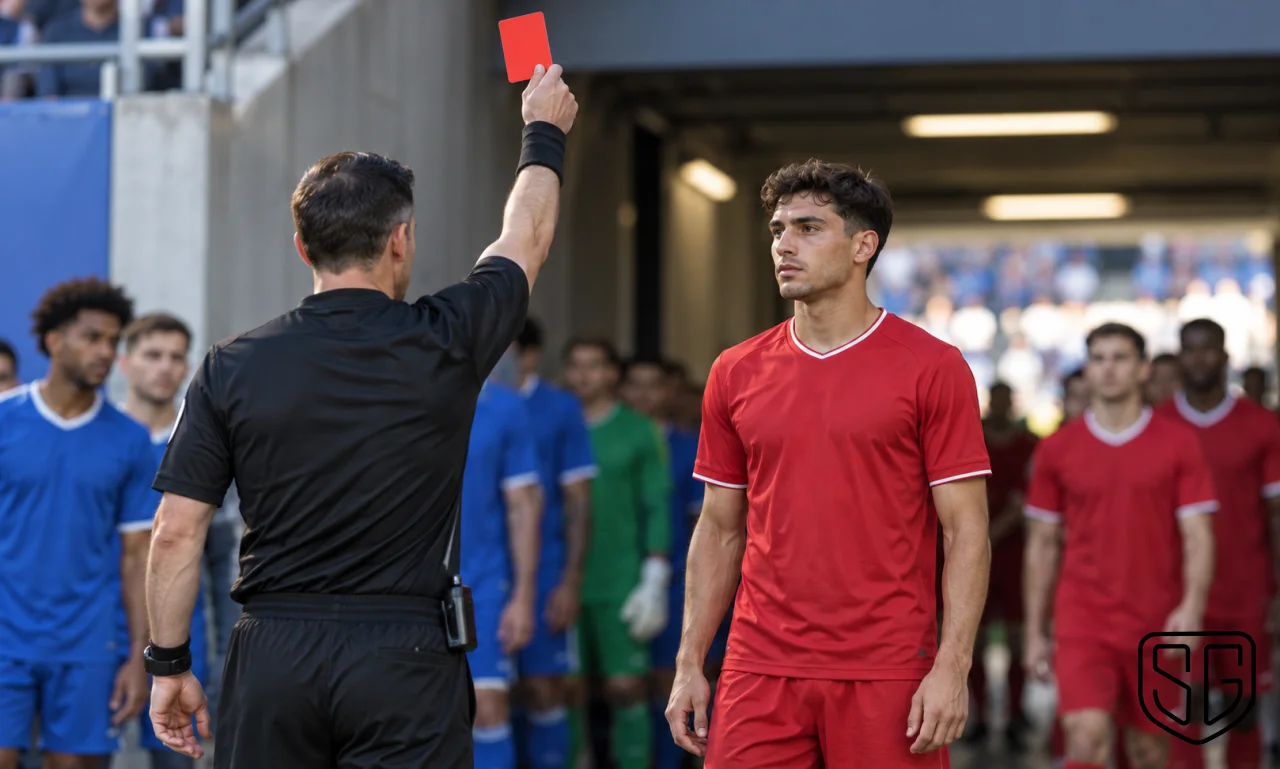
Yes, a player can be sent off before kick-off and prevented from taking part. IFAB Law 3 explains the consequences, including whether a replacement is allowed. The answer to 'must the team start with ten?' depends on when the dismissal happens and whether the player has already been named on the team list.
Pre-match does not mean outside the referee's authority. Serious misconduct during the build-up can affect participation before the ball has moved. However, exclusion from the match, the physical display of a red card and the team's replacement options are separate points. Keeping them distinct makes this unusual situation much easier to understand.
What happens before the team list is submitted?
A player dismissed before submission cannot be named on the team list in any capacity. They cannot simply be moved from the starting line-up to the bench. The team can select its eligible players for the list, subject to the relevant competition requirements. The dismissed person's exclusion is not permission to ignore registration or eligibility rules.
Imagine a hypothetical warm-up confrontation before the lists have been handed in. If a player commits a sending-off offence within the referee's disciplinary authority, the coach cannot keep that person available as a substitute. The practical task is to complete an eligible list and inform the officials correctly, rather than treating the incident as a warning that expires at kick-off.
Can a named starter be replaced?
A player already named on the team list who is sent off before kick-off may be replaced by a named substitute. That substitute's vacated place cannot be filled. Law 3 also states that the number of substitutions the team may make during the match is not reduced. Losing a bench option and using an in-match substitution are different things.
For example, suppose a team has named eleven starters and nine substitutes. One starter is dismissed before kick-off and a named substitute takes their place. The side can still begin with eleven, but the bench now has one fewer available player. It is misleading to announce that every pre-match dismissal necessarily forces a ten-player start.
What if the dismissed person is a substitute?
A named substitute who is sent off before or after kick-off cannot be replaced. Their dismissal does not itself remove one of the starting eleven. A reader should first identify the person's role on the submitted list: the same red-card symbol beside a player's name does not always mean the team must remove someone from the field.
Once kick-off has taken place, a sent-off player cannot be replaced. That makes the timing important. A confrontation seconds before the opening restart and an offence seconds after it can have different replacement consequences. The referee's record of the sequence matters more than a television graphic that describes both incidents loosely as happening 'at the start'.
When does the referee's authority begin?
Law 5 describes the referee's powers, while Law 12 covers disciplinary action. Disciplinary authority begins when the referee enters the field for the pre-match inspection and continues through the prescribed post-match period. A sending-off offence before the teams enter for the start can prevent participation and must be reported.
The ability to show cards has its own timing provisions. IFAB's official examples explain that a dismissal during the earlier warm-up stage can be dealt with by exclusion and reporting without physically showing a red card. Spectators should therefore avoid assuming that somebody remains eligible solely because no raised card appears in a warm-up clip.
Does the referee award a free kick as well?
A pre-match dismissal does not turn the opening restart into a free kick for the opponents. Law 8 governs kick-off, and Law 12 distinguishes disciplinary action from offences committed while the ball is in play. The referee can deal with misconduct before the match starts while preserving the correct procedure for starting the game.
The length of any later suspension is a separate matter for the relevant disciplinary authority and competition rules. It cannot be inferred from the replacement procedure alone. No universal number of banned matches should be attached to every pre-match sending-off, particularly when the nature of the misconduct and applicable regulations have not been established.
A practical checklist for an unusual incident
Check whether the list had been submitted, whether the person was a starter or substitute, and whether kick-off had occurred. Those facts explain most replacement questions. Our substitute interference guide covers a related distinction between players and bench personnel. All examples here are hypothetical explanations of IFAB's current rules, checked on 20 October 2026, rather than claims about a specific disciplinary case.