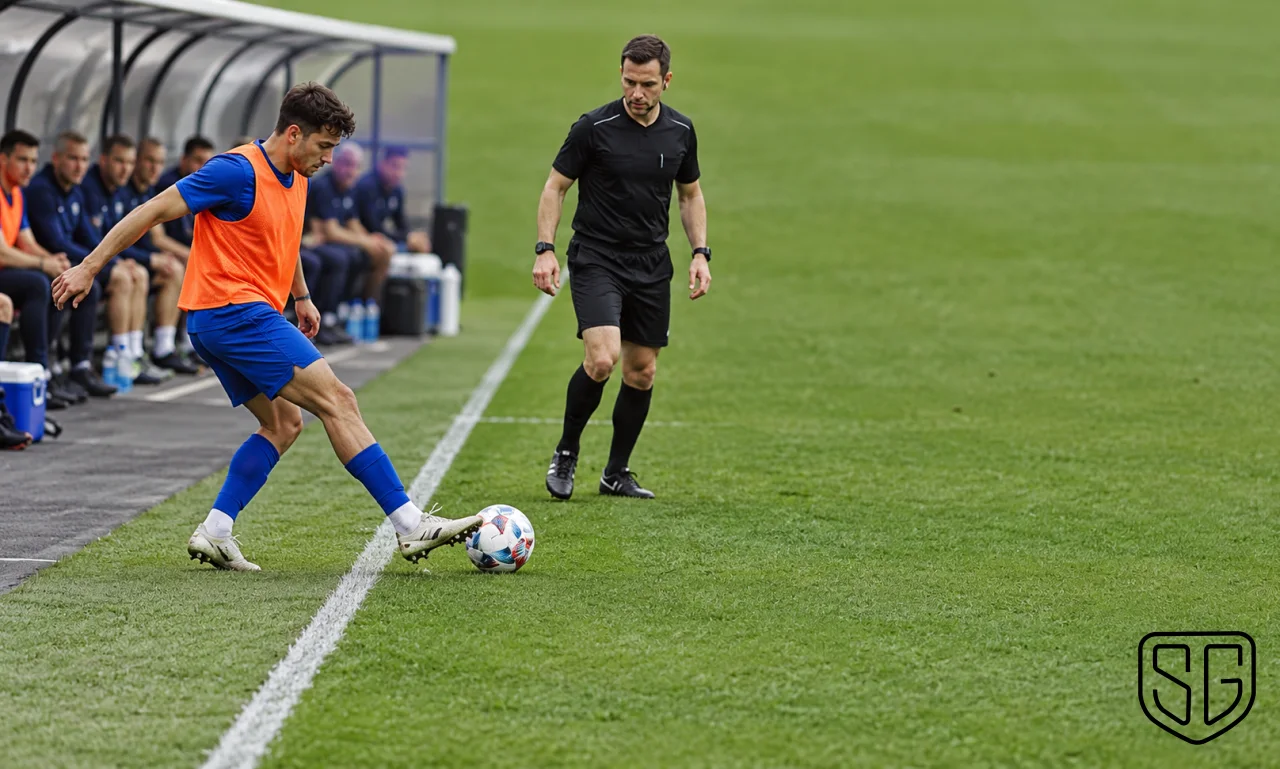
If the ball hits the referee, play does not automatically stop. Under IFAB Law 9, a dropped ball is required when it touches a match official, stays on the field and causes a promising attack to start, goes directly into goal, or changes the team in possession. Otherwise, an incidental deflection can leave the ball in play.
That distinction explains why apparently similar incidents can produce different decisions. A ball brushing the referee's boot is not itself an offence by either team. The important question is what the contact does to the game. A harmless change of direction and a deflection that gifts an opponent possession are not treated as the same event.
When can the referee let play continue?
Imagine a hypothetical defender passing sideways across midfield. The ball clips the referee and still reaches the intended team-mate, with no promising attack created. If none of Law 9's stopping conditions applies, play can continue. There is no general requirement to whistle simply because a match official has made accidental contact with the ball.
Players should therefore keep following the game until the referee stops it. Appealing while an otherwise live ball rolls away can create avoidable confusion. From the touchline, it helps to watch where the pass was going and which team controls the outcome, rather than calling for a dropped ball immediately after every contact with an official.
What if possession changes or an attack begins?
A deflection that changes the team in possession is one of the specified triggers. So is contact that starts a promising attack, even if the same team keeps the ball. The referee need not wait for a shot before recognising that the official's involvement has created the kind of attacking advantage covered by the law.
In a second illustrative example, a sideways pass hits the referee and runs into open space behind the defensive line. A forward from the passing team collects it with a clear attacking route. The fact that possession stayed with that team does not settle the decision: the promising-attack condition must also be checked. The rule addresses the effect of the interference, not just the colour of the next shirt to touch the ball.
Can a goal count straight off the referee?
If contact with a match official sends the ball directly into goal while the conditions in Law 9 apply, play is stopped and restarted with a dropped ball. The official's body cannot supply a legitimate final deflection into the net in that situation. Law 10 should be read together with this specific ball-out-of-play provision.
That is different from treating the referee as a defender who has scored an own goal. A referee is neither team's player. Describing the incident that way may be convenient in conversation, but it hides the actual restart decision. The referee must restore play using the dropped-ball procedure rather than recording a goal against a player who never touched it.
Who gets the dropped ball?
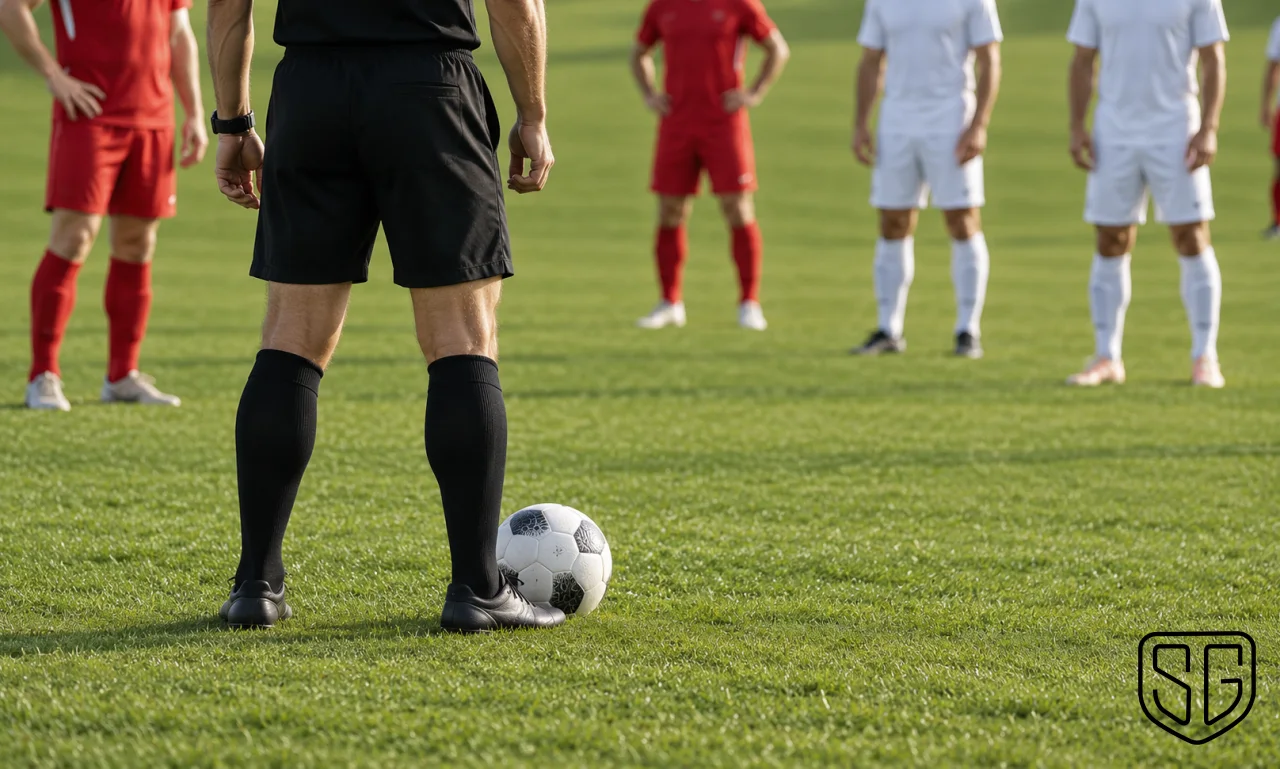
Law 8 sets out the current dropped-ball procedure. Outside the penalty area, the recipient is a player from the team that had or would have retained or gained possession, where the referee can determine that. Otherwise, the fallback is the team that last touched it. For contact with an official, the drop is at the contact position.
This means 'always give it to the last team to touch it' is incomplete advice. A pass may clearly have been travelling to an opponent before the referee intervened. Inside the penalty area, the law provides for the defending goalkeeper to receive the dropped ball. Other players must remain at least four metres away, and the ball becomes live on touching the ground.
What should players and spectators check?
Use three questions: did the ball remain on the field, did an identified stopping condition result, and where did the contact occur? Then look at the referee's decision on possession. Law 5 gives the referee responsibility for applying the laws; a loud appeal does not determine who receives the restart.
A dropped ball should also be distinguished from interference by a bench player. Our substitute interference guide explains why that can require a free kick instead. These hypothetical examples are intended to help readers recognise the decision, without suggesting that every accidental touch has an identical outcome. The rules were checked against IFAB's current edition on 20 October 2026.