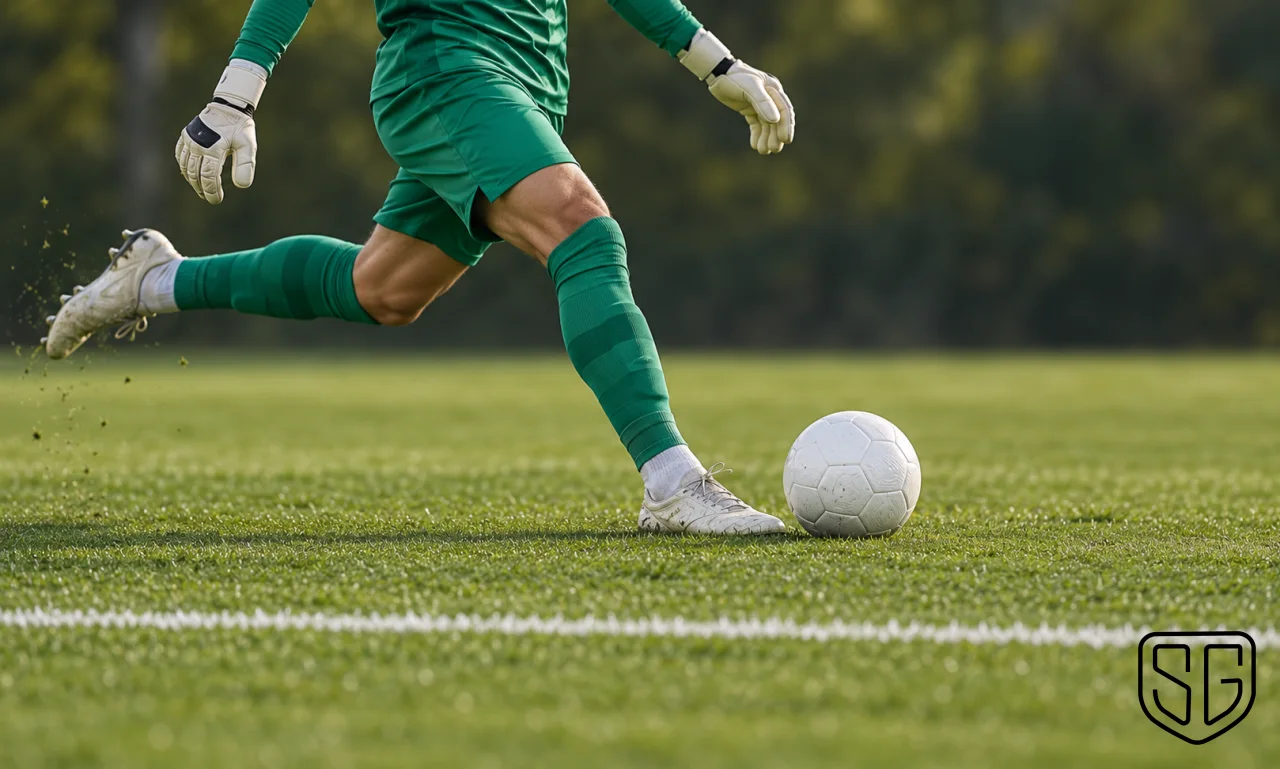
A goalkeeper cannot take a goal kick or free kick and then play the ball again before another player touches it. The usual decision for a second touch with the foot is an indirect free kick. IFAB Law 16 applies that restriction to goal kicks, while Law 13 covers free kicks. Wearing gloves does not give the restart taker a separate right to retrieve a misplaced pass.
The answer changes when the phrase 'touch twice' describes ordinary possession. After receiving a legal pass, a goalkeeper can take several touches with their feet. The restriction concerns the player who actually took the restart, and lasts until another player makes contact. Understanding who kicked the ball first is more useful than counting every subsequent movement.
When does a goal kick become live?
A goal kick enters play once the stationary ball is kicked and clearly moves. It does not need to leave the penalty area. A goalkeeper who nudges it only a short distance has therefore started play if the movement satisfies the law. An underhit delivery is not automatically an unfinished restart that can simply be taken again.
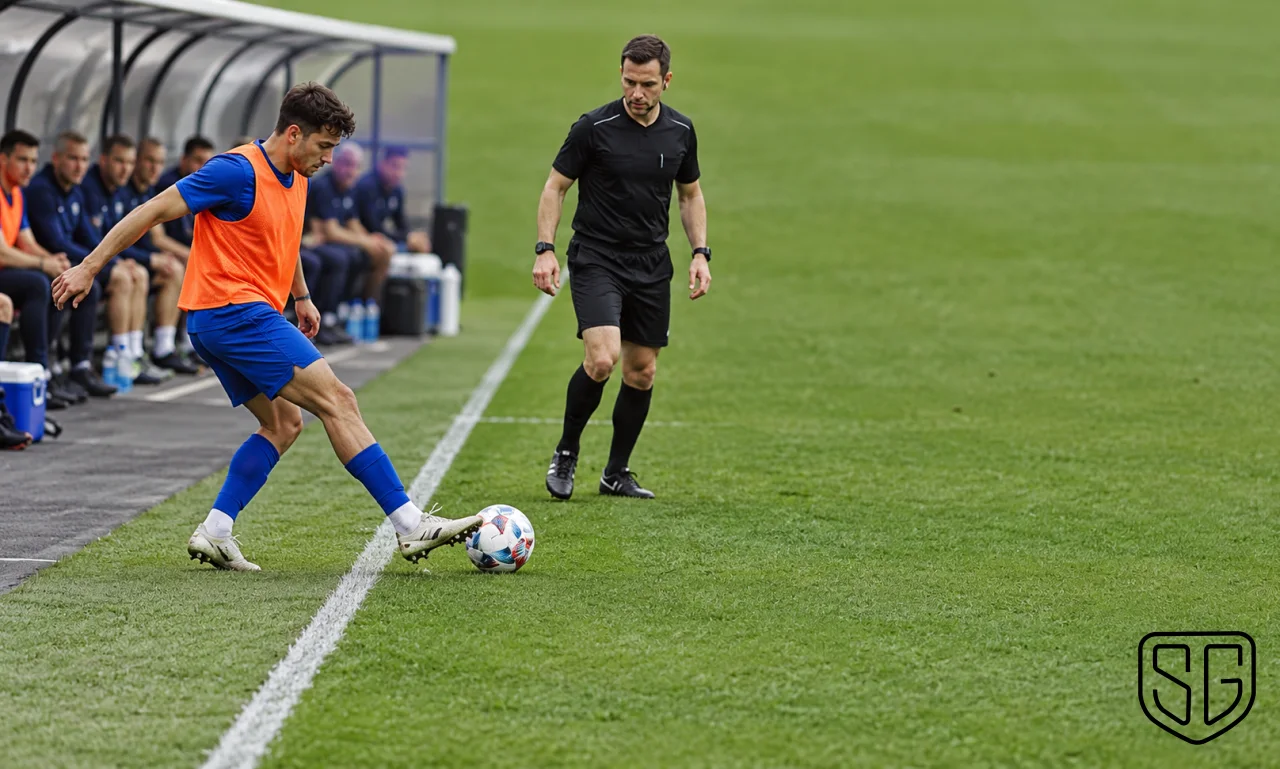
Consider a hypothetical training example: the goalkeeper aims towards a centre-back, but the pass stops several metres short. The centre-back hesitates as an attacker approaches. If the goalkeeper runs forward and kicks it away before anyone else touches it, the second-touch restriction applies. A team-mate merely moving towards the pass does not supply the missing contact.
Does a rebound allow another touch?
A post or crossbar is not another player. If a restart hits the frame and comes back to its taker, that rebound alone does not remove the restriction. Equally, a bounce on the turf does not turn one pass into a new passage of possession. The relevant event is contact by a different player, not a change in the ball's direction.
A team-mate's genuine touch does meet that requirement, as does an opponent's. Afterwards, the goalkeeper can normally play the ball with their feet again. Handling remains a separate question: a deliberate kick from a team-mate can engage the restrictions in Law 12. Permission to take another foot touch should never be read as automatic permission to catch the ball.
What if the goalkeeper picks it up?
Inside their own penalty area, a goalkeeper who handles their own goal kick before another player touches it concedes an indirect free kick. Outside the area, the goalkeeper is subject to ordinary handball rules. Location therefore matters when deciding the restart; it is inaccurate to describe every goalkeeper double touch as a penalty.
There is also a distinct restriction after a goalkeeper releases a ball from their hands in normal play: they cannot handle it again before it touches another player. That should be separated from taking a goal kick. A roll to the ground during possession and a formal restart may look similar in a short clip but have different factual starting points.
Can the goalkeeper receive a yellow or red card?
Yes. Law 12 specifically requires disciplinary action when an illegal second touch after a restart stops a promising attack or denies a goal or an obvious goal-scoring opportunity. A second touch can matter even when made with a boot. The referee assesses the attacking situation; neither an automatic red card nor a blanket exemption is correct.
In the hypothetical underhit-pass example, an attacker moving towards an open goal presents a different problem from an attacker far away with several defenders covering. Spectators should avoid deciding the sanction from the goalkeeper's panic alone. The referee needs the ball's position, the opponents' opportunities and the surrounding players to judge what the offence actually prevented.
Which situations are different?
A dropped ball is not a kick taken by the recipient. Once it has touched the ground, the receiving player may dribble; Law 8 does not impose the same one-touch-until-a-team-mate rule. A goalkeeper collecting that restart should therefore not be judged as though they had just taken a goal kick.
For a quick check, identify the restart, identify its taker and look for another player's contact. Then consider handling and any lost attacking opportunity separately. SportsGround's team-mate throw-in guide explains a related handling restriction, while our goal-kick scoring guide covers the scoring exception. These examples illustrate the rules checked on 20 October 2026; they do not describe a particular match.