If a substitute touches the ball and interferes with play, the referee can award a direct free kick to the opponents, or a penalty if the interference occurs inside the substitute's team's penalty area. IFAB Law 3 for 2026/27 governs extra people on the pitch. The card decision depends on what the substitute did; interference is not automatically the same disciplinary offence in every situation.
A person listed on the bench is not entitled to join play simply because they are wearing their team's kit. A substitution must follow the referee-controlled procedure. A ball approaching the touchline is still live until it has completely crossed it. That makes the location, timing and effect of the contact important.
When does a substitute become a player?
Under the substitution procedure, the substitute enters during a stoppage, at halfway, after the replaced player has left and after receiving the referee's signal. The substitution is completed when the substitute enters. From then, they are a player and may take a restart. Until that point, they cannot assume the rights of a player already participating.
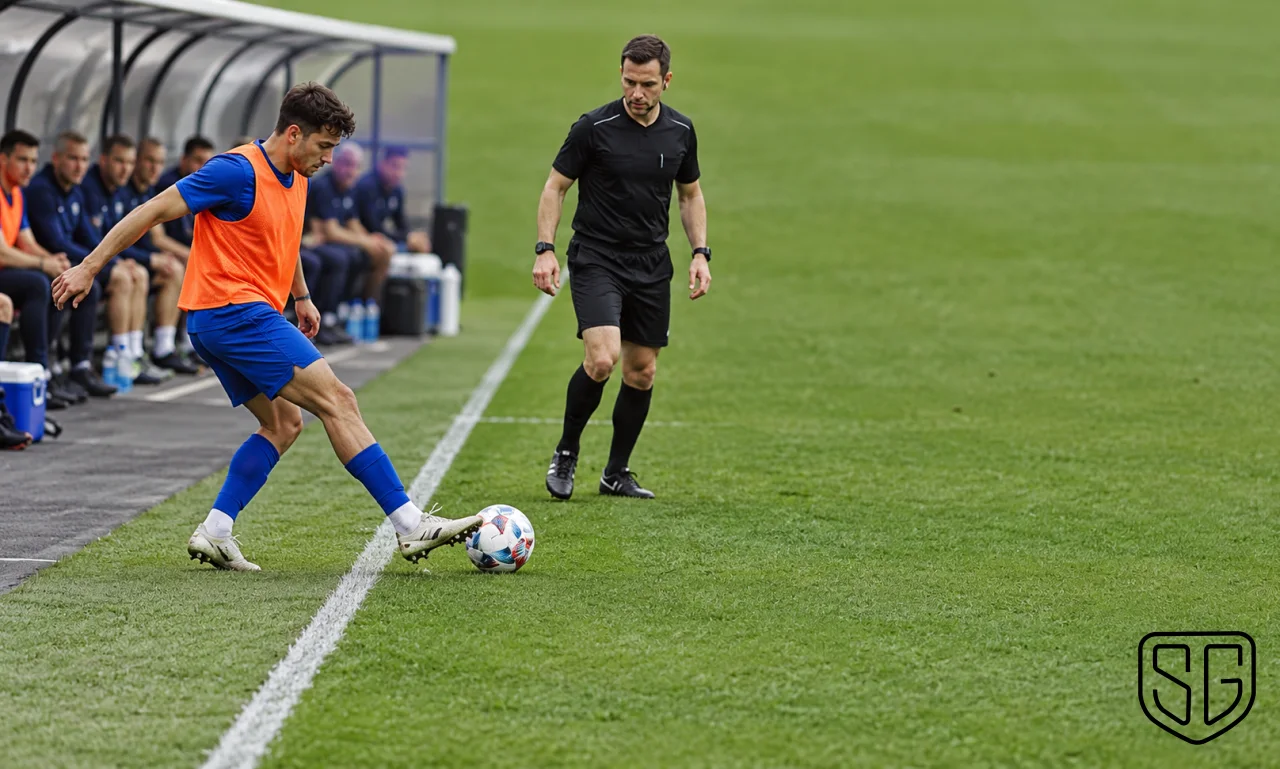
Imagine an illustrative situation in which a replacement is waiting for the board to be raised. A loose pass rolls towards them inside the touchline and they step on to keep possession for their team. No substitution has been completed. The referee treats this as interference by a substitute, not an ordinary interception by a newly introduced player.
Why a direct free kick or penalty?
Law 3 distinguishes team-related extra persons from outside agents. Interference by a substitute, substituted player, sent-off player or team official normally leads to a direct free kick or penalty. The location of the interference matters. A bench player stopping the live ball within their own team's penalty area can therefore concede a penalty even without being one of the eleven players.
That is different from assuming all unauthorised entries produce a dropped ball. Outside-agent interference is a separate category. A spectator and a named substitute do not have identical status under the law. Referees must identify who interfered before choosing the restart, rather than treating everyone arriving from beyond the boundary in the same way.
Is the substitute always sent off?
No. Law 12 sets out disciplinary offences for substitutes, including entering without permission, delaying a restart and unsporting behaviour. More serious actions can lead to a sending-off, such as violent conduct or denying an obvious goal-scoring opportunity in circumstances covered by the law. The referee must judge the actual offence, not simply the fact that the person came from the bench.
A substitute who has already been cautioned can also be sent off for a second cautionable offence. That does not mean an on-field player automatically leaves as well. The distinction between the team's available substitutes and its players on the pitch matters. Law 12's official examples explain that a substitute's dismissal does not itself reduce the permitted number of substitutions.
Can the referee still award a goal?
Law 3 contains a specific provision for a ball already going into the goal. If interference does not prevent a defending player from playing the ball and the ball enters, the goal is awarded even if contact occurred, unless the interference came from the attacking team. A defender's substitute therefore cannot necessarily prevent a goal being awarded simply by reaching for the ball.
The referee also distinguishes an extra person's mere presence from interference. Someone stepping onto the grass away from play is not automatically a reason to cancel a goal. Law 3 requires removal and appropriate disciplinary action, but the effect on play is central. These provisions avoid rewarding interference while preserving a legitimate goal where the law permits it; they are not permission for substitutes to participate.
What if the ball was already out?
Once the whole ball has crossed the boundary or play has already stopped, the existing restart is normally retained. A substitute kicking it away might still be disciplined for delaying the opponents' restart, but that does not turn an already awarded throw-in into a penalty. Law 12 separates misconduct from the restart when the ball is out of play.
For spectators, check three things in order: was the ball live, was the person an authorised player, and did their action interfere? SportsGround's throw-in rules guide covers a common subsequent restart. The examples here are hypothetical explanations of the current laws, not claims about a particular match.