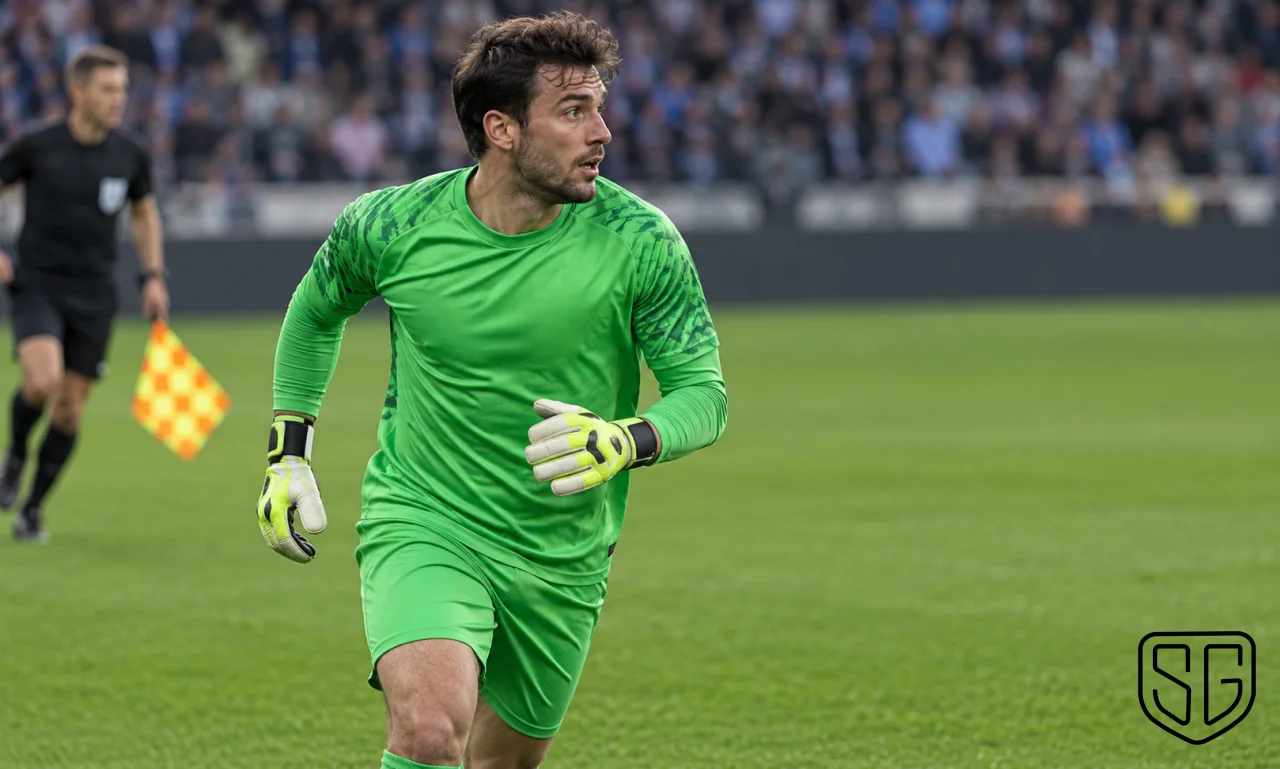
Yes, a goalkeeper can be offside in football. When a goalkeeper joins their team's attack, IFAB Law 11 applies the same position and involvement tests as it does to any other player. The goalkeeper's shirt and gloves do not provide an exemption from an offside offence at the other end of the pitch.
The more common confusion concerns the defending goalkeeper. Offside is judged against the ball and the second-last opponent, rather than a fixed rule about the last defender. Those opponents can include the goalkeeper, but their positions on the field can change. Understanding that wording helps explain unusual late-game situations when a keeper has gone forward.
When is an attacking goalkeeper in an offside position?
The relevant parts of the player must be in the opponents' half and nearer the opponents' goal line than both the ball and the second-last opponent. Hands and arms are excluded from that position test, including a goalkeeper's hands and arms. Being level with the second-last opponent does not put a player offside.
Imagine a hypothetical goalkeeper staying forward after an attacking move. A team-mate is preparing a pass from midfield. If the goalkeeper is beyond both the ball and the second-last opponent when that pass is played, they may occupy an offside position. The fact that they travelled from their own penalty area a few seconds earlier does not alter the snapshot at the pass.
Is standing there enough for an offence?
No. Position alone is not an offence. Law 11 also requires involvement in active play, such as playing the team-mate's pass or interfering with an opponent in a way covered by the law. A goalkeeper can stand beyond the offside line without automatically causing the referee to stop an unrelated action.
In the hypothetical pass, the advanced goalkeeper might run onto the ball and shoot, making the involvement clear. Alternatively, they might obstruct the defending goalkeeper's view of a team-mate's shot. A useful analysis follows both the original position and the subsequent action; identifying the bright goalkeeper shirt in an advanced position answers only the first part.
What happens when a keeper comes up for a corner?
There is no offside offence when a player receives the ball directly from a corner kick. That exception applies to the attacking goalkeeper too. SportsGround's corner-kick offside guide explains it. The exception concerns the direct delivery, rather than granting immunity for the remainder of the attacking move.
If a team-mate then heads or plays the ball towards the goalkeeper, that later touch can create a new offside assessment. A keeper who was legally positioned for the original corner may therefore need to adjust as the move continues. The same principle helps explain why a player can be onside for one phase and offside at the next team-mate's touch.
Does the defending goalkeeper always set the line?
No. Law 11 refers to the second-last opponent, without reserving a special place for the goalkeeper. If the defending keeper races well upfield, two outfield players may be the last two opponents nearer their own goal line. Conversely, with only one opponent beyond an attacker, being behind that lone opponent is not enough by itself.
Think of a counter-attack after a keeper has gone forward. A defender remaining near the goal can be the last opponent, while the goalkeeper is nowhere near the goalmouth. Spectators should count opponents and compare the attacker with the ball, rather than looking for a goalkeeper as a compulsory reference point. The positions decide the assessment.
What about receiving from an opponent?
Offside normally concerns a team-mate's play or touch. A defender's deliberate play can change the assessment, while a deflection or deliberate save has different consequences. These are fact-sensitive distinctions in Law 11. A goalkeeper waiting forward cannot assume that every slight defensive contact removes an earlier offside position.
Nor can an attacking keeper use their hands to finish. Law 12 applies ordinary handling restrictions outside their own penalty area, and Law 10 provides the scoring framework. The permission to act as an attacking player does not carry their own-penalty-area handling privilege across the pitch.
Use the same checklist as for an outfield attacker: position at the relevant team-mate's touch, the ball, the second-last opponent and subsequent involvement. Law 3 identifies the goalkeeper as one of the team's players; the role does not create a separate offside law. All examples here are hypothetical, based on the current IFAB rules checked on 21 October 2026.