The most useful wall passing drills for beginners are the ones that reveal whether a pass is accurate and the next touch is controlled. Start with a gentle two-touch exchange before adding angle, distance or speed. A wall provides repetition, but it does not automatically tell you whether the repetition is improving your technique.
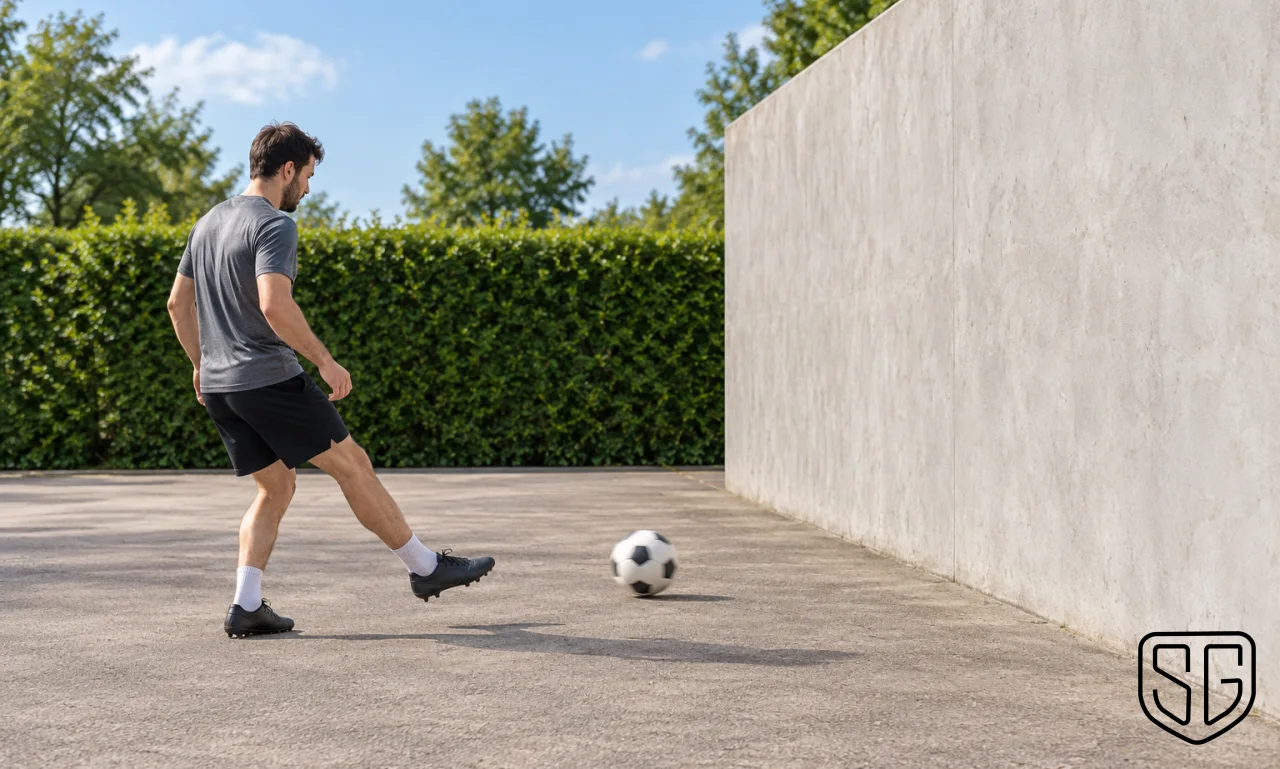
Use only a wall you have permission to use, with no windows, traffic, doors or bystanders in the rebound area. Check the surface underfoot and leave space behind you. Pass softly enough to control the return. If the location is not suitable, choose another practice rather than improvising against somebody's property.
Set up a two-touch accuracy drill
Stand a few comfortable steps from a solid wall and choose a small visible target near its base. Play a gentle inside-foot pass, receive the rebound and stop it before passing again. Keep your starting position consistent. Count ten attempts, noting both target hits and returns you control without a chase.
Aim for a predictable contact through the ball rather than a forceful swing. Adjust the support foot and body position if the ball repeatedly travels to one side. England Football Learning covers different passing techniques; for this beginner exercise, a short controlled ground pass is more appropriate than trying driven or lofted deliveries.
Receive across the body
After a gentle pass, use the first touch to move the rebound slightly across you, then return it with the other foot. Leave enough space between touches to stay balanced. Practise both directions. If the return comes too quickly, step farther away only where the surface and surrounding area allow it.
The objective is not simply to touch the ball twice. The receiving touch should place it where the next pass is comfortable. A touch trapped underneath you may force an awkward adjustment; one pushed too far away creates a chase. Use the same test on each side rather than judging the less comfortable foot more harshly.
Add a small passing angle
Move slightly to one side after your pass so the return is no longer coming straight at your starting point. Take a controlled touch and pass back towards the target. Keep the movement small at first. Do not turn the exercise into a sprint after a rebound that has escaped your intended practice area.
Repeat from the other side of the target. Notice whether your hips and feet allow you to face the next pass naturally. If you keep twisting at the last moment, slow down and set your body earlier. This drill adds positioning demands without requiring a complicated course or a large collection of equipment.
When to try one-touch passing
Only add a one-touch round when two-touch exchanges are consistently controlled. Begin with soft returns from a manageable distance and aim for five accurate passes rather than an endless streak. Stop the ball and reset when the rhythm becomes frantic. A long sequence of increasingly inaccurate contacts is not the target.
Alternate a short one-touch round with a two-touch round. This lets you compare what changes when preparation time is reduced. If accuracy drops sharply, return to the slower version. A beginner does not need to master one-touch passing before taking part in suitable small-sided games or ordinary team training.
Track the right details
Record the distance, preferred foot, target hits and controlled returns. Keep the target size and ball consistent when comparing sessions. Change one variable at a time: a narrower target, a different receiving direction or a slightly longer pass. Do not increase power merely because the exercise begins to feel familiar.
The FA practice-spectrum guidance makes clear that technical repetition and realistic football are different learning situations. A wall never presses you or changes its supporting run. Use these exercises alongside games, not instead of them. Our first-touch training guide provides more receiving work; bring one useful cue from today's wall session into your next practice with team-mates.