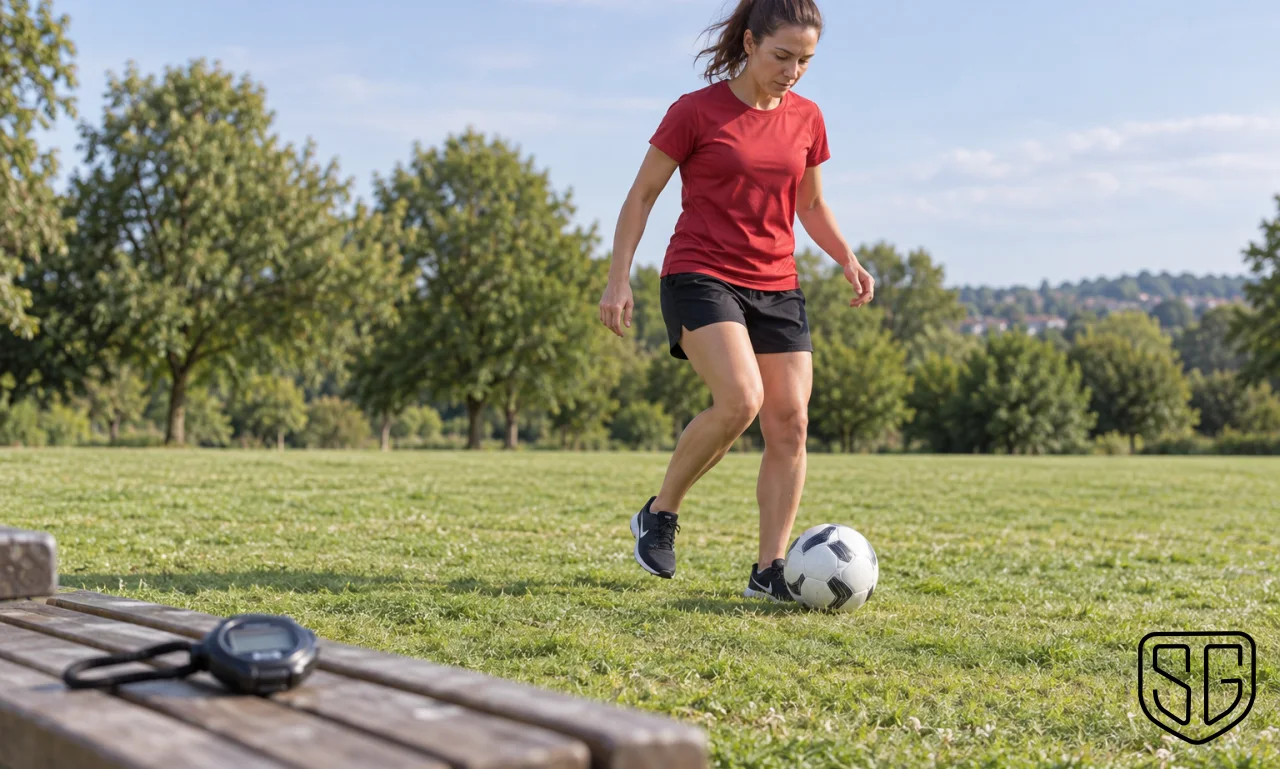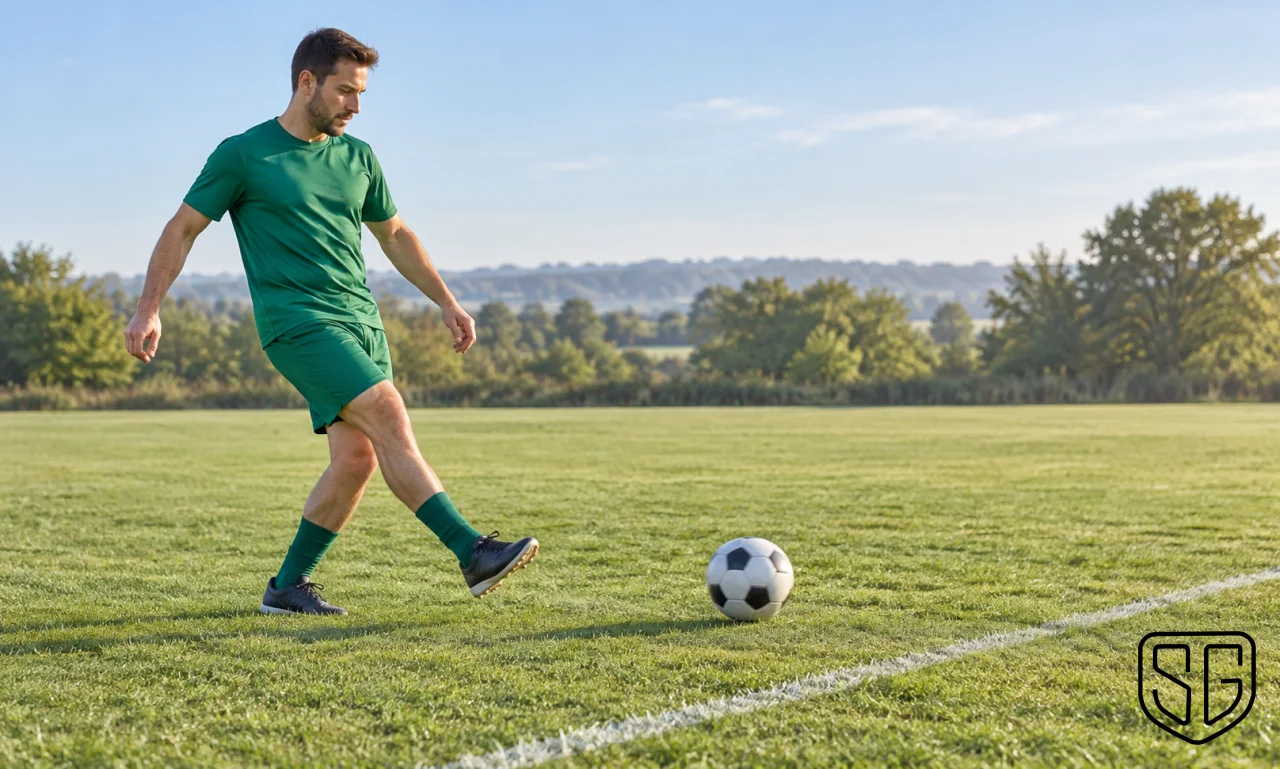
Practising football dribbling without cones starts with choosing a route and deciding what control should look like along it. Existing pitch markings or imaginary turning points can organise a useful exercise. You do not need a line of objects to work on touch size, direction changes or keeping the ball available for your next action.
This guide is an original suggested progression for beginners, rather than a professional training prescription. It differs from a general list of home drills by concentrating on how to design and assess a dribbling route. Begin at walking pace on a safe surface and make each stage dependable before adding speed.
Draw the route in your mind
Find a clear area where football is permitted. Choose two existing ground markings with a generous turning space at each end. Walk the route without a ball first, checking that you can stop comfortably. Avoid furniture, bottles, stones or bags as substitutes for cones: improvised obstacles can introduce hazards rather than improve the exercise.
Make your first route straight and short enough to observe the ball throughout. The return leg should have the same usable width as the outward leg. If you have to squeeze around somebody else's equipment or move towards traffic to complete a turn, choose another space instead of trying to compensate with better technique.
Match the touch to the space
Move down the route using gentle touches with the inside and outside of one foot, then return using the other. Aim to keep the ball close enough for a comfortable next step. A touch that works in a wide area may be too large near a boundary, so judge the contact against the space available.
England Football Learning discusses ball manipulation through varied contacts and movement. Use that broad principle to explore small adjustments rather than copying one rigid touch pattern. If the ball repeatedly runs away, slow your movement and soften the contact before shortening the route or making the turn more demanding.
Give every turn a clear exit
Approach the end slowly, redirect the ball and leave towards the starting point. Pause after each turn if necessary. First practise an inside-foot turn, then try a sole-based change of direction if it feels comfortable. The useful outcome is a balanced exit, not merely spinning your body while the ball stays behind.
Repeat the same turn on both sides and notice which part causes difficulty. You may approach too quickly, plant the support foot awkwardly or touch the ball across your own path. Work on one cause at a time. Our weak-foot practice guide can help organise slower work on the less familiar side.
Add a cue without pretending it is a defender
Once the route is controlled, choose between two safe exit directions before each attempt. Alternatively, briefly glance towards a visible landmark between touches, then return attention to the ball. Do not look away for so long that you lose awareness of the surface or people entering the practice area.
A self-chosen cue adds variety, but it is not the same as responding to an opponent. You already know the options and control the timing. The FA explains the difference between technique practice and realistic skill development. Later, use suitable games with other players to explore protecting the ball and recognising genuinely available space.
Measure control before chasing a faster time
Try five journeys under the same conditions. Count those completed with a controlled turn and no boundary escape. Write down the reason for each miss. A faster time achieved by letting the ball travel beyond reach should not count as improvement when the purpose of the exercise is dependable close control.
When you can repeat the route calmly, change one factor: the foot used, the exit direction or the movement speed. Keep the other conditions stable so comparison remains meaningful. A smooth surface and a rough patch will produce different ball behaviour, so record the location as well as the result.
Transfer the movement beyond the route
A fixed route helps you isolate a problem, but football rarely provides identical turns in sequence. Finish by moving freely within the safe area and choosing when to stop, turn or change direction. Keep the same standard of control even though the order is no longer predictable.
For a broader menu, our cone-free football drills offers other practice options. Use those selectively rather than repeating similar exercises without a purpose. Cones can make boundaries visible, but their absence does not prevent thoughtful dribbling practice: a clear task, safe space and honest feedback matter more than the equipment count.